We constantly hear from facility managers who are frustrated by floors that peel or wear down entirely too fast. The daily grind of forklift traffic and chemical spills can destroy a standard floor coating in just a few months.
At Epoxy Flooring Pro, our team wants to help you avoid these expensive failures by explaining exactly how these premium coatings work. This rapid deterioration usually happens because the wrong type of resin was specified for a heavy-duty environment.
The key difference is the actual volume of solids left on the floor after the curing process.
We are breaking down everything you need to know, including What Is 100% Solid Epoxy Flooring? Benefits, Cost, and Industrial Applications. Let’s look at the chemistry behind these systems, review current installation costs, and outline the exact preparation steps required for success.
What Does 100% Solid Epoxy Actually Mean?
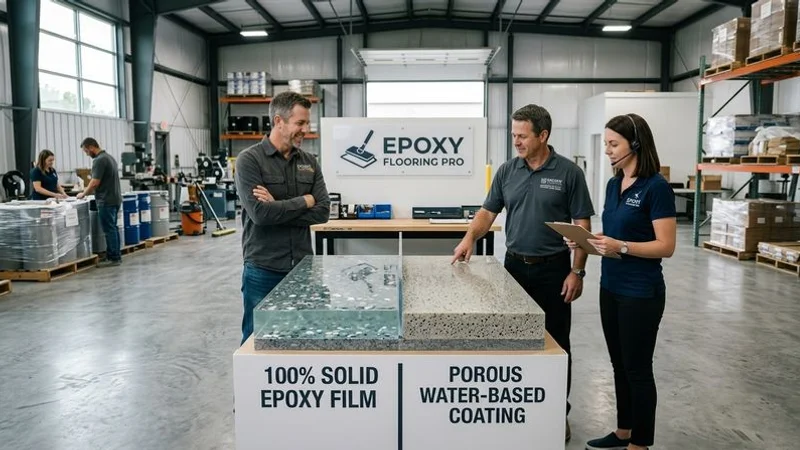
We evaluate coating performance by looking at the volume solids content. When a 100% solid epoxy is applied at 10 mils wet film thickness, it cures to exactly 10 mils dry film thickness. Nothing evaporates. Every molecule you apply becomes part of the finished protective film.
We frequently see the consequences of using cheaper, water-based alternatives that contain 40 to 60 percent water by volume. A water-based epoxy applied at 4 mils wet will shrink to just 1 or 2 mils as the water carrier evaporates during the curing process. Solvent-based systems behave similarly, losing a massive portion of their applied volume to evaporation.
We always remind industrial facility managers that this distinction dictates exactly how much protection your concrete receives. Film thickness directly correlates to coating longevity, chemical resistance, and abrasion performance. Let’s break down the difference between wet and dry thickness.
| Coating Type | Typical Wet Film Thickness | Typical Dry Film Thickness | Shrinkage Level |
|---|---|---|---|
| Water-Based Epoxy | 4 to 6 mils | 1 to 2 mils | High |
| Solvent-Based Epoxy | 5 to 7 mils | 2 to 3 mils | High |
| 100% Solid Epoxy | 10 to 20 mils | 10 to 20 mils | Zero |
The Chemistry Behind Superior Performance
Our installation crews rely on the precise chemical reactions of these premium coatings. Industrial 100% solid epoxy systems consist of two components: a bisphenol A epoxy resin and a polyamine or polyamide hardener. When mixed at the correct ratio, these components undergo an irreversible cross-linking reaction that produces an extremely dense, non-porous polymer matrix.
Standard concrete typically maxes out at a compressive strength of 3,000 to 4,000 psi. Our specified 100% solid epoxy floors easily achieve compressive strengths over 10,000 psi. This transforms a basic concrete slab into a structural surface capable of handling extreme abuse.
The absence of solvents or water carriers means the cured film contains no voids, pinholes, or micro-channels where chemicals can penetrate to the concrete below. This fully dense film structure is what gives these floors their exceptional chemical barrier properties.
Key Benefits for Industrial Facilities
Zero VOC Emissions
We highly recommend these formulations for projects trying to meet strict indoor air quality standards. Because 100% solid epoxy contains no solvents or water carriers, it produces zero volatile organic compound emissions during application and cure. This eliminates the need for respiratory protection beyond standard dust masks, and it allows application in occupied buildings with proper ventilation.
Facilities operating in regions with aggressive EPA enforcement find this especially helpful. State regulators in places like California and Washington frequently cap VOCs for floor coatings at 50 grams per liter, making compliance a major headache for older solvent products. A zero-VOC solid epoxy completely bypasses these compliance hurdles and keeps your project legally sound.
Superior Build Thickness
Our crews can establish an incredibly thick protective layer in a single pass. A single coat of 100% solid epoxy achieves 8 to 20 mils of dry film thickness depending on the application method. Self-leveling formulations can build to 40 mils or more in a single pour, which equates to roughly 1/16th of an inch of solid protection.
Achieving an equivalent thickness with water-based systems would require three to five separate coats with drying time between each application. Fewer coats means less labor, shorter project timelines, and a faster return to service. For a 50,000-square-foot warehouse, the labor savings alone can easily offset the higher material cost of premium systems.
Extended Service Life
We consistently see a massive return on investment when calculating the long-term lifespan of these floors. Properly installed 100% solid epoxy floor coatings routinely deliver 10 to 20 years of service in heavy industrial environments. Water-based systems in the exact same conditions typically require total re-coating every 3 to 5 years.
When calculated on a life-cycle cost basis, the higher upfront investment in 100% solid epoxy always delivers a lower cost per year of service. Facility managers avoid the repeated operational downtime required to tear out and replace cheaper failing coatings.
Chemical and Abrasion Resistance
Our technical specifications prioritize objective testing data to prove durability. The dense, void-free film structure of 100% solid epoxy provides the highest level of chemical resistance available in standard epoxy chemistry.
These premium coatings resist prolonged exposure to several harsh substances:
- Hydraulic fluids and petroleum products
- Dilute acids and alkalis
- Salt solutions and deicing chemicals
- Most industrial solvents at moderate exposure durations
Abrasion resistance is equally impressive when subjected to the strict ASTM D4060 Taber abrasion test. This US standard uses a rotating abrasive wheel to measure material loss. Testing consistently shows 100% solid epoxy losing less than 25 milligrams per 1,000 cycles, compared to 60 to 100 milligrams for water-based alternatives.
Cost Per Square Foot Breakdown
We want to give you a realistic look at current US market pricing for 2026. Material costs for 100% solid epoxy systems range from $45 to $150 per gallon depending on mil thickness and the specific product grade. Installed costs, including professional surface preparation, application, and cure time, typically range from $4.00 to $10.00 per square foot for standard industrial applications.
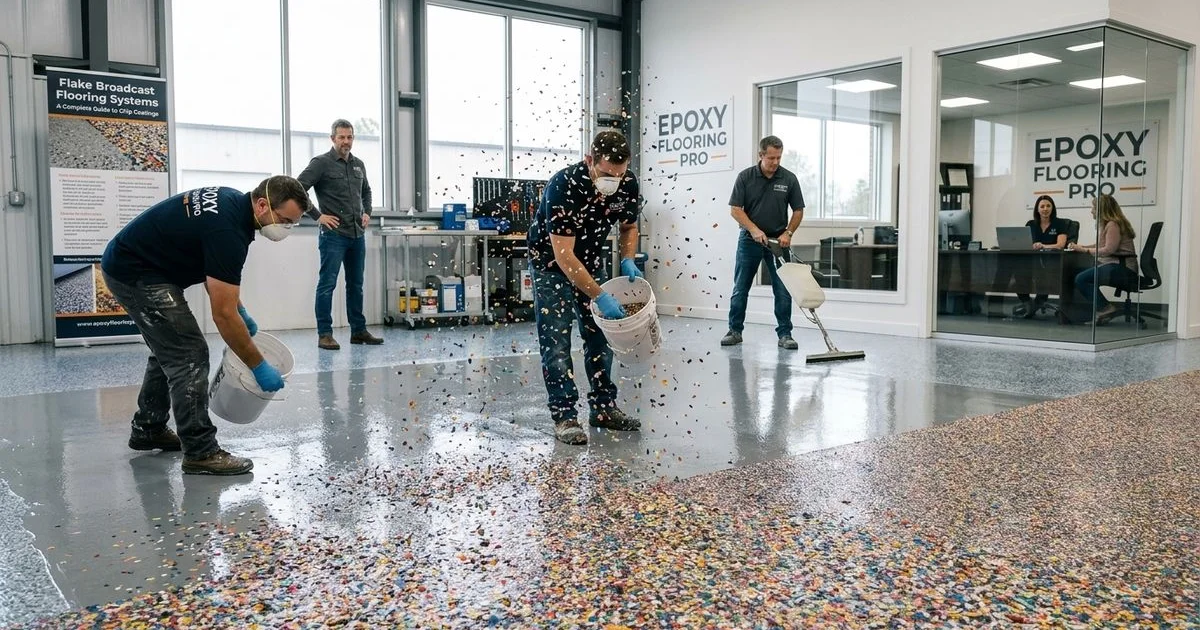
Pricing fluctuates heavily based on the amount of concrete repair required before the coating goes down. Premium systems incorporating quartz broadcast, multi-coat builds, or specialized topcoats can reach $10.00 to $15.00 per square foot installed.
These premium specifications are reserved for pharmaceutical, food processing, or cleanroom environments where regulatory compliance demands maximum performance.
Common Industrial Applications
Manufacturing Plants
We frequently specify these thick systems for facilities dealing with constant mechanical stress. Heavy manufacturing environments with forklift traffic, steel-wheeled carts, and dropped tooling demand maximum film thickness. The seamless, non-porous surface also simplifies housekeeping and prevents coolant or hydraulic fluid from penetrating the concrete substrate.
Warehousing and Distribution
Our team uses these coatings to help logistics centers comply with strict safety regulations. High-traffic distribution centers benefit from the abrasion resistance and long service life of 100% solid epoxy.
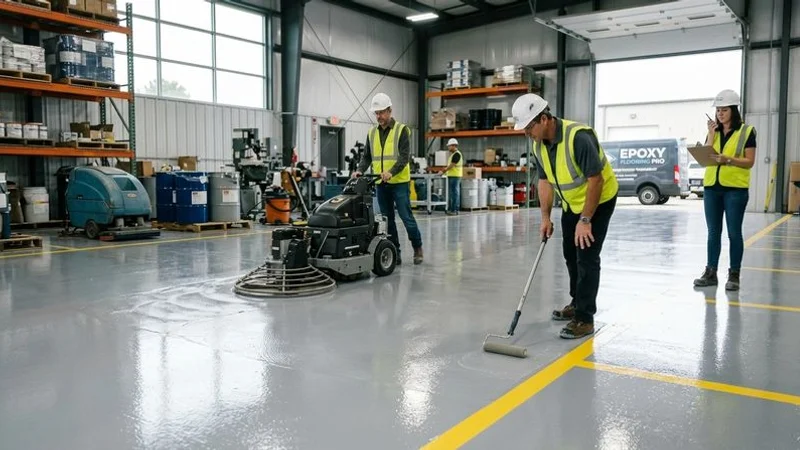
US OSHA standard 1910.22 mandates that permanent aisles must be appropriately marked and kept clear. We can embed permanent 4-inch yellow safety lines and red hazard zones directly into the solid epoxy following OSHA & 5-S floor striping standards. This creates an OSHA-compliant floor solution rather than just a basic protective coating.
Automotive and Aerospace
We install these floors in specialized assembly areas, paint preparation rooms, and heavy maintenance bays. These environments require a surface that can resist highly aggressive aviation fluids like Skydrol, as well as acetone and MEK. A 100% solid epoxy handles these chemical exposures effortlessly, whereas a thinner water-based option would rapidly degrade and peel.
Application Requirements and Limitations
We must emphasize that 100% solid epoxy is absolutely not a weekend DIY product. Successful installation requires strict environmental controls and mechanical preparation that standard paint crews simply cannot execute.
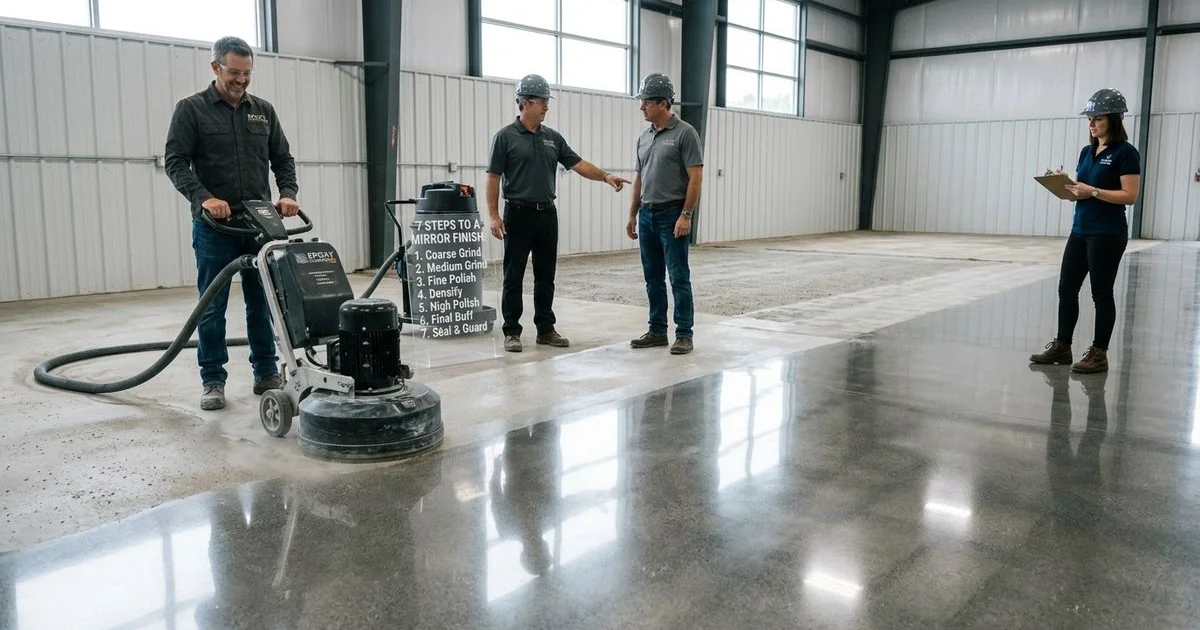
The number one cause of floor failure is inadequate concrete surface preparation. We adhere to the International Concrete Repair Institute (ICRI) standards for measuring a Concrete Surface Profile (CSP). A true 100% solid system requires a CSP of 3 to 5, which looks and feels like the texture of medium sandpaper.
Achieving this specific profile requires industrial equipment and skilled labor.
- Professional surface preparation using heavy shot blasting or diamond grinding to achieve the correct CSP 3 to 5 rating
- Precise mixing of resin and hardener at exact manufacturer-specified ratios
- Temperature control with ambient and substrate temperatures maintained above 50 degrees Fahrenheit
- Experienced application crews who understand pot life management and proper spreading technique
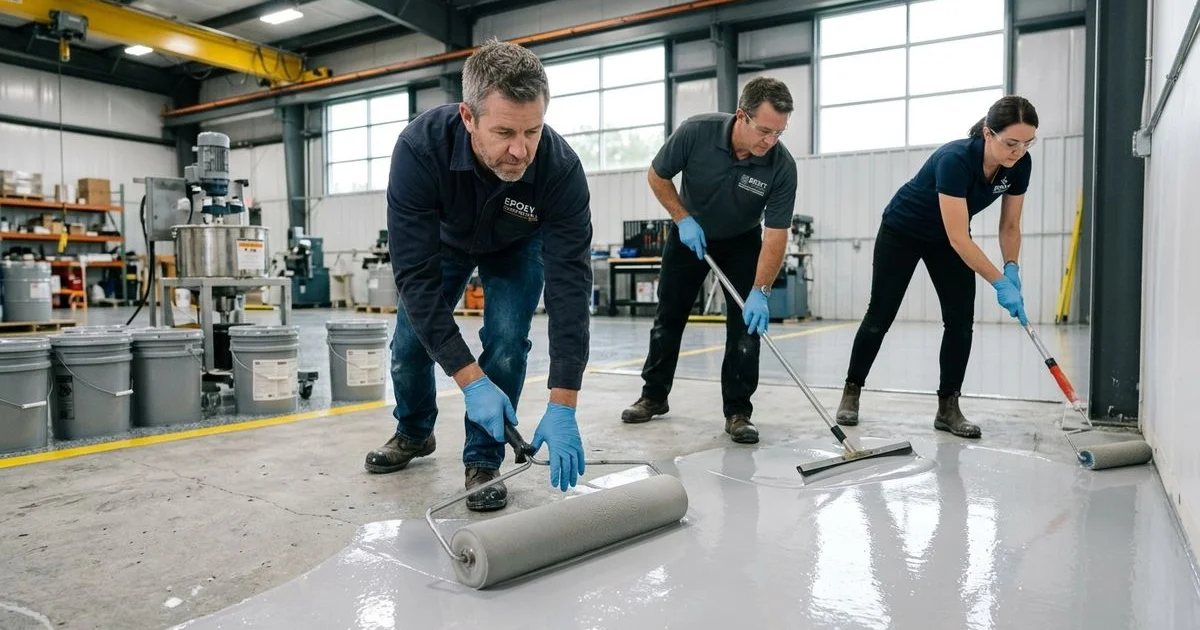
The higher viscosity of these systems compared to thinned products means application requires significantly more skill and physical effort. Roller application demands heavier nap rollers and more passes to achieve perfectly uniform coverage.
Is 100% Solid Epoxy Right for Your Facility?
We know that investing in the right protective layer early will save your maintenance budget for years to come. If your facility demands maximum chemical resistance, a 10-year lifespan, and zero VOC emissions, this is almost certainly the correct specification. The slightly higher material cost is completely offset by fewer coats, longer re-coating intervals, and a reduced total cost of ownership.
For facilities with tight shutdown windows, consider pairing a base coat with a fast-cure polyaspartic topcoat to combine durability with rapid return-to-service times. Our team specializes in specifying and installing these exact premium systems for industrial facilities across the region.
If you are still asking yourself What Is 100% Solid Epoxy Flooring? Benefits, Cost, and Industrial Applications, we are here to help. Contact us for a complimentary site assessment and a customized coating recommendation matched to your daily operational requirements.
Need Help With Your Floor Coating Project?
Our project managers provide free on-site assessments tailored to your facility.
Get a Free Estimate