We see this happen every single year.
Facility managers invest heavily in a new floor coating, only to watch it peel up a few months later. Our team at Epoxy Flooring Pro receives desperate calls about these failures constantly. The main culprit behind this costly mess is almost always thermal shock.
This rapid temperature change occurs when boiling water or hot cleaning solutions hit a surface, followed immediately by a cold rinse.
Let’s look at the data to understand why standard coatings fail under these conditions. Then, we will explore the only industrial material engineered to survive this extreme abuse.
Why Standard Epoxy Fails in Thermal Shock Environments
We often explain to plant engineers that concrete and standard epoxy are chemically incompatible under extreme heat. A standard epoxy coating has a coefficient of thermal expansion that is vastly different from the concrete slab beneath it.
Our experience shows that this massive differential creates a literal breaking point. Concrete expands at a rate of roughly 5.5 microstrains per degree Fahrenheit. Standard epoxy expands at three to five times that rate.
When a clean-in-place (CIP) system dumps 200-degree water onto a 40-degree floor, the two materials expand at competing speeds. This generates immense shear stress at the bond line. The epoxy literally rips itself away from the concrete substrate.
| Material | Coefficient of Thermal Expansion (in/in/°F) | Reaction to 200°F Water Dump |
|---|---|---|
| Concrete Substrate | ~ 5.5 x 10^-6 | Minimal, slow expansion |
| Standard Epoxy | ~ 15.0 to 30.0 x 10^-6 | Rapid expansion, resulting in delamination |
| Urethane Cement | ~ 6.0 x 10^-6 | Expands at the same rate as concrete |
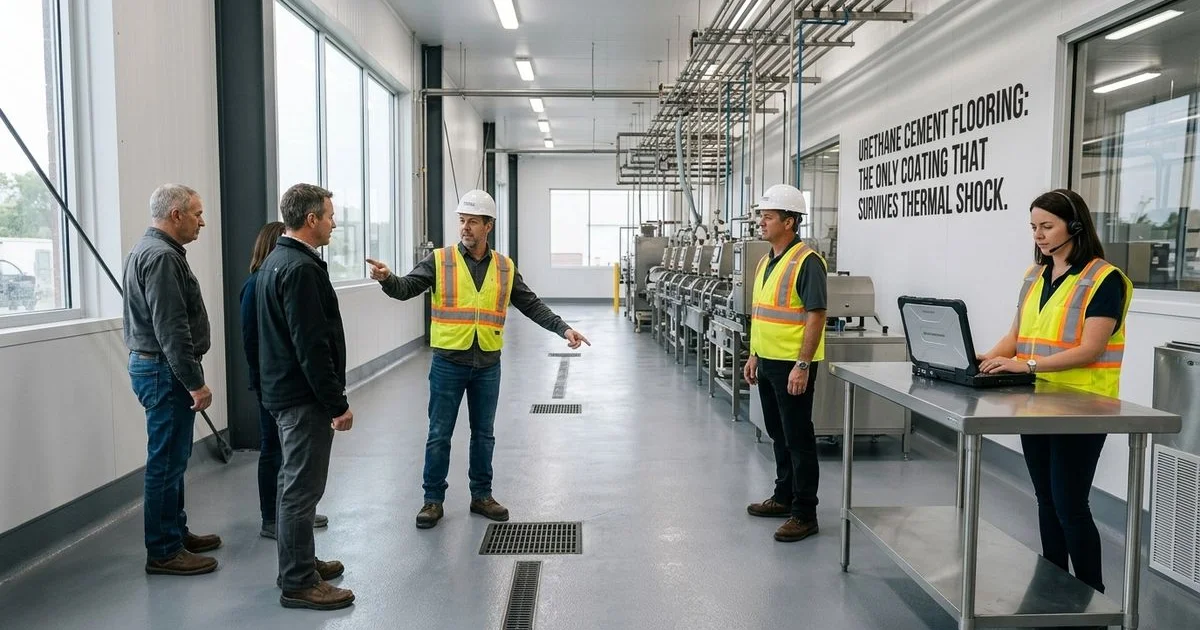
Urethane cement, also called cementitious urethane or urethane mortar, is the only floor coating technology specifically engineered to withstand this type of thermal cycling without bond failure.
What Makes Urethane Cement Different
We consider urethane cement to be a hybrid powerhouse material. It combines polyurethane resin chemistry with a Portland cement aggregate.
This specific combination creates a coating with a thermal expansion rate that almost perfectly matches the concrete slab underneath.
The cementitious component provides compressive strength and thermal stability. The polyurethane binder delivers extreme chemical resistance, flexibility, and adhesion.
You get a monolithic floor system that easily handles continuous operating temperatures from -40 to 250 degrees Fahrenheit without degradation.
Here are the specific performance metrics that separate it from standard epoxy:
- Moisture Tolerance: Urethane cement breathes. It can withstand up to 99% Relative Humidity (RH) according to ASTM F2170 testing standards.
- Impact Resistance: The aggregate structure absorbs heavy impacts from dropped kegs or loaded forklifts without shattering.
- Thermal Matching: It expands and contracts in unison with the building’s foundation.
Industries That Require Urethane Cement
Food and Beverage Processing
USDA and FDA-regulated facilities represent the largest US market for urethane cement flooring. These environments combine thermal shock from hot water washdowns with aggressive chemical exposure from caustic cleaners and acidic food products. Our food & beverage flooring solutions are specifically designed for these demanding conditions.
Our crews see firsthand how the latest 2026 Food Safety Modernization Act (FSMA) enforcement guidelines heavily penalize facilities with cracked or peeling floors. A properly installed urethane cement system meets all USDA acceptance requirements for direct food contact environments.
The seamless, non-porous surface prevents bacterial harborage. The integral cove base eliminates the 90-degree wall-to-floor joint where dangerous listeria and salmonella bacteria typically accumulate.
Breweries and Distilleries
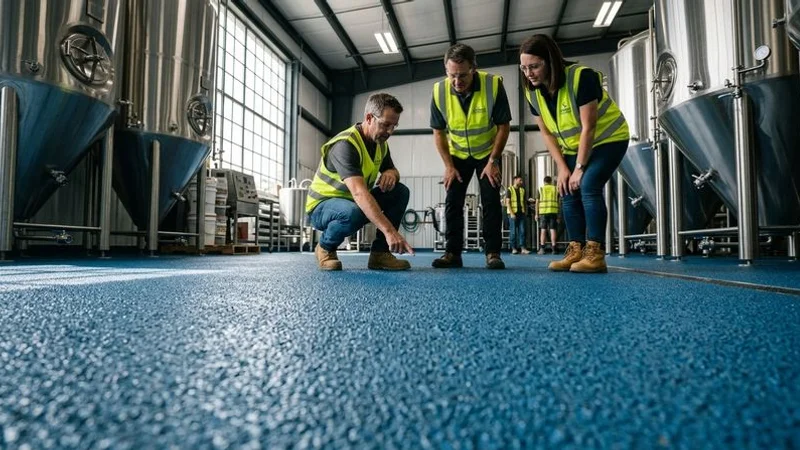
Brewery floors face a uniquely punishing combination of stresses. Hot wort spills routinely exceed 200 degrees Fahrenheit in the brewhouse.
We constantly replace failed epoxy floors that were eaten alive by acidic fermentation byproducts. Lactic and acetic acids dissolve standard concrete at a rapid pace. Standard epoxy systems typically fail within two years in a heavy production brewery.
Urethane cement systems routinely deliver 15 to 20 years of continuous service in these exact same conditions. Floor drains and stainless steel trench systems are seamlessly integrated into the urethane cement pour to create a fully waterproof drainage system.
Commercial Kitchens
Institutional and commercial kitchens experience severe thermal shock patterns. Deep fryers splash hot oil that often exceeds 350 degrees Fahrenheit.
Our clients in the restaurant sector use urethane cement to provide the necessary chemical resistance against cooking oils and heavy-duty degreasing chemicals. It also helps facilities meet strict safety codes.
Current ANSI A326.3 standards require specific slip resistance ratings for wet commercial environments. Urethane cement can be broadcast with quartz or aluminum oxide to easily exceed the required 0.42 Dynamic Coefficient of Friction (DCOF) rating.
Pharmaceutical Manufacturing
Cleanroom pharmaceutical environments require flooring that can withstand aggressive sanitization and heavy equipment loading.
We install urethane cement in these spaces because it easily resists industrial sterilants like Spor-Klenz and Vaporized Hydrogen Peroxide (VHP). It delivers excellent chemical resistance while maintaining the seamless, crevice-free surface that strict Good Manufacturing Practice (GMP) regulations demand.
Installation Process and Timeline
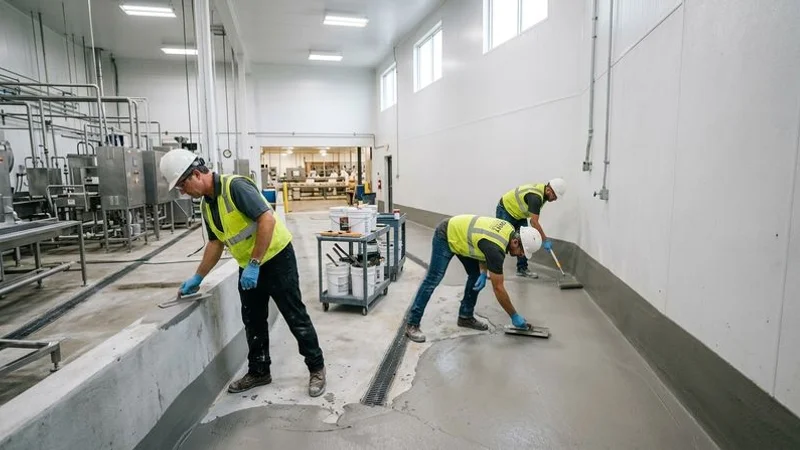
We approach urethane cement installation with a very different skill set than standard epoxy application. The material cures rapidly and requires precise timing.
The standard installation process follows these critical steps:
- Heavy Surface Preparation: Concrete must be mechanically profiled using shot blasting or scarification. Industry standards (ICRI) require a heavy surface profile, typically a CSP-4 or CSP-5, to ensure a permanent mechanical bond. Learn more about concrete surface preparation methods.
- Moisture-Tolerant Priming: A penetrating urethane primer is applied to the raw concrete. This creates a chemical bridge between the substrate and the overlay.
- Rapid Application: The mixed material is poured, gauge-raked, and troweled to the specified thickness. We typically install this at 1/4 to 3/8 inch thick for high-traffic applications.
- Protective Topcoat: A polyaspartic or chemical-resistant polyurethane topcoat seals the surface and locks in the slip-resistant aggregate.
Total installation time for a typical US project ranges from 3 to 5 days. Return to light foot traffic is usually possible within 12 to 24 hours after the final topcoat application.
Cost Considerations
Urethane cement is a premium floor coating system. You can expect US pricing to range from $12 to $25 per square foot installed, depending on thickness, topcoat specification, and concrete condition.
This pricing reflects the specialized heavy-duty materials, skilled labor, and extensive concrete profiling required. However, the alternative is not a cheaper coating. The alternative is repeated coating failures and massive operational downtime.
Recent 2026 industry data shows that unexpected facility downtime costs US manufacturers an average of $50,000 per hour. When you evaluate the total cost of ownership over a 15-year lifecycle, doing the job right the first time becomes the obvious choice.
| System Type | Initial Cost (Per Sq Ft) | Expected Lifespan in Washdown Areas | Estimated 15-Year Replacement Cost |
|---|---|---|---|
| Standard Epoxy | $5 - $9 | 1 to 3 Years | Very High (Multiple replacements + downtime) |
| Urethane Cement | $12 - $25 | 15 to 20+ Years | Very Low (Zero required replacements) |
Urethane Cement vs. Epoxy: When to Use Each
The decision between these two systems should always be driven by your facility’s environmental conditions.
We use a very simple checklist to guide our clients:
- Temperature swings exceeding 50 degrees Fahrenheit: Urethane cement is mandatory.
- Steam cleaning or hot water wash-downs: Urethane cement is mandatory.
- Constant ambient temperatures with no thermal cycling: Epoxy is appropriate and more cost-effective.
- USDA/FDA regulated areas with thermal exposure: Urethane cement is the only compliant choice.
Many facilities benefit from a hybrid zoned approach. You specify urethane cement for harsh processing and washdown zones. Then, you utilize standard epoxy systems to protect warehousing, dry packaging, and office areas where thermal shock is not an issue.
Specifying the Right System for Your Facility
Correct specification requires a thorough understanding of your facility’s daily thermal profile and chemical exposure matrix. Over-specifying wastes capital budget. Under-specifying guarantees a premature failure.
Our team has installed millions of square feet of urethane cement systems in breweries, food processing plants, commercial kitchens, and pharmaceutical facilities across the country.
We know exactly what works in the real world. Contact us for a comprehensive site assessment and a custom specification that solves your facility’s exact thermal shock challenges permanently.
Need Help With Your Floor Coating Project?
Our project managers provide free on-site assessments tailored to your facility.
Get a Free Estimate