Why Slip Resistance Is a Non-Negotiable Floor Property
We at Epoxy Flooring Pro often see plant engineers treating floor coatings as a basic maintenance task rather than a critical safety asset. From what I have observed on facility floors across the US, this mindset changes rapidly when exploring Slip-Resistant Industrial Flooring: Aggregate Options and Safety Standards.
Our team routinely reviews data showing that slips and falls cost American businesses approximately $70 billion annually in medical expenses and compensation.
That $70 billion figure is exactly why slip resistance is a non-negotiable floor property.
“A single slip injury now averages over $40,000 in direct costs, making preventative flooring upgrades an urgent financial priority for US facilities.”
We know that smooth epoxy and urethane flooring coatings become dangerously slippery when wet or oily. Anti-slip performance must be actively engineered into the system through the broadcast application of hard, angular aggregate particles.
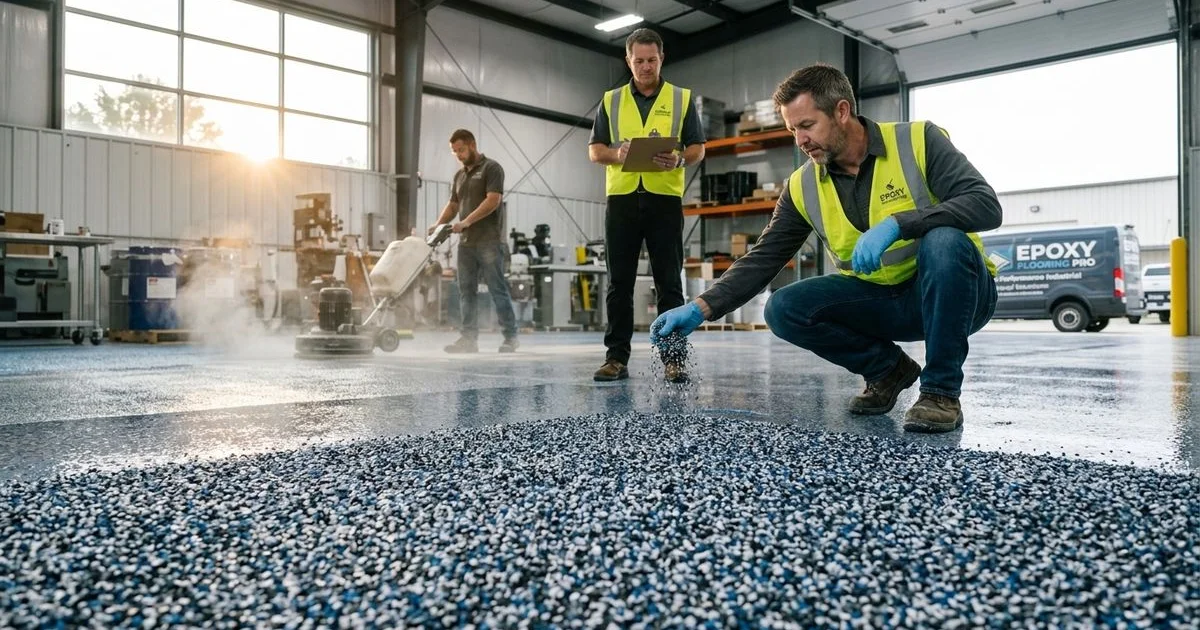
Our preferred method involves embedding these particles into the wet coating during installation to create micro-peaks that grip footwear. The specific type, size, density, and application method of the aggregate dictate your long-term traction.
We are going to break down the most effective materials for industrial environments. Let’s look at the data, what it is actually telling us, and explore a few practical facts to help you choose the right system.
Aggregate Types and Their Properties
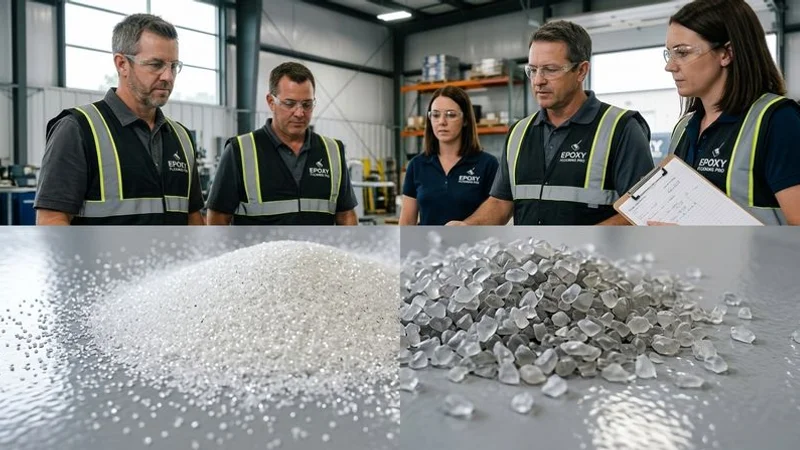
Aluminum Oxide
Our standard recommendation for demanding industrial zones is aluminum oxide. This material ranks at a 9 on the Mohs hardness scale, placing it just below diamonds in terms of durability.
We rely on aluminum oxide because its sharp, angular cutting edges hold up under years of heavy forklift and foot traffic. This sustained angularity provides long-lasting traction that softer aggregates simply cannot match. Our installations using this material consistently maintain safe friction levels for a decade or more.
The sharp particle geometry cuts through fluid films that would defeat softer, rounder aggregates.
- Best applications: Manufacturing plants, warehouses, loading docks, mechanical rooms, chemical processing areas
- Available mesh sizes: 12 (very coarse), 16, 20, 36 (fine)
- Color: White to gray, does not significantly affect coating color
- Service life: 5 to 10+ years before re-broadcast is needed in most US industrial environments
Quartz (Silica Sand)
We frequently specify quartz aggregate for spaces requiring a balance between moderate slip resistance and easy cleaning. The particles feature a sub-angular to rounded shape that creates a highly refined texture.
Our tests show that quartz easily meets the ANSI A326.3 standard of 0.42 Dynamic Coefficient of Friction (DCOF) for wet interior spaces. This makes it a reliable choice for areas with lighter contamination.
We often use quartz in environments where aesthetics and cleanability share priority with safety. Softer than aluminum oxide, this material wears faster under heavy industrial traffic and requires re-application sooner.
- Best applications: Commercial kitchens, restrooms, retail spaces, healthcare corridors
- Available mesh sizes: 20, 30, 40, 50
- Color: Available in multiple colors for decorative applications
- Service life: 3 to 5 years
Polymer Beads
We utilize spherical polymer beads to provide a subtle surface texture without adding aggressive grit. Installers mix these particles directly into the topcoat rather than broadcasting them onto the wet surface.
Our clients appreciate that polymer beads improve wet traction without visually altering the smooth coating finish. This approach works perfectly for light-traffic areas where heavy industrial contaminants are absent.
We find that polymer grit helps achieve safe friction levels in dry environments like corporate offices. The smooth, spherical shape means dirt does not easily accumulate on the floor.
- Best applications: Retail showrooms, corporate lobbies, light-traffic areas
- Application method: Mixed directly into the topcoat
- Service life: 2 to 3 years
Matching Aggregate to Facility Conditions
We customize every aggregate specification based on the distinct slip hazards present in your specific facility. A universal approach inevitably leads to either inadequate traction or excessive cleaning difficulty.
Our flooring specialists recommend a zoned strategy for most large manufacturing plants. Aggressive aluminum oxide belongs in production areas, while smoother quartz treatments work best in office corridors or restrooms.
| Environment | Primary Hazard | Recommended Aggregate | Mesh Size |
|---|---|---|---|
| Loading docks | Water, oil, debris | Aluminum oxide | 12-16 |
| Production floors | Oil, coolant spills | Aluminum oxide | 16-20 |
| Wet processing areas | Constant water | Aluminum oxide | 12-16 |
| Commercial kitchens | Grease, water | Quartz | 20-30 |
| Retail and showrooms | Tracked-in rain | Polymer beads | Fine |
| Healthcare corridors | Wet mopping residue | Quartz | 30-40 |
We evaluate the primary contaminants in each zone before making a final material recommendation. Constant water exposure requires a different friction profile than heavy petroleum-based lubricants.
Application Methods
Full Broadcast
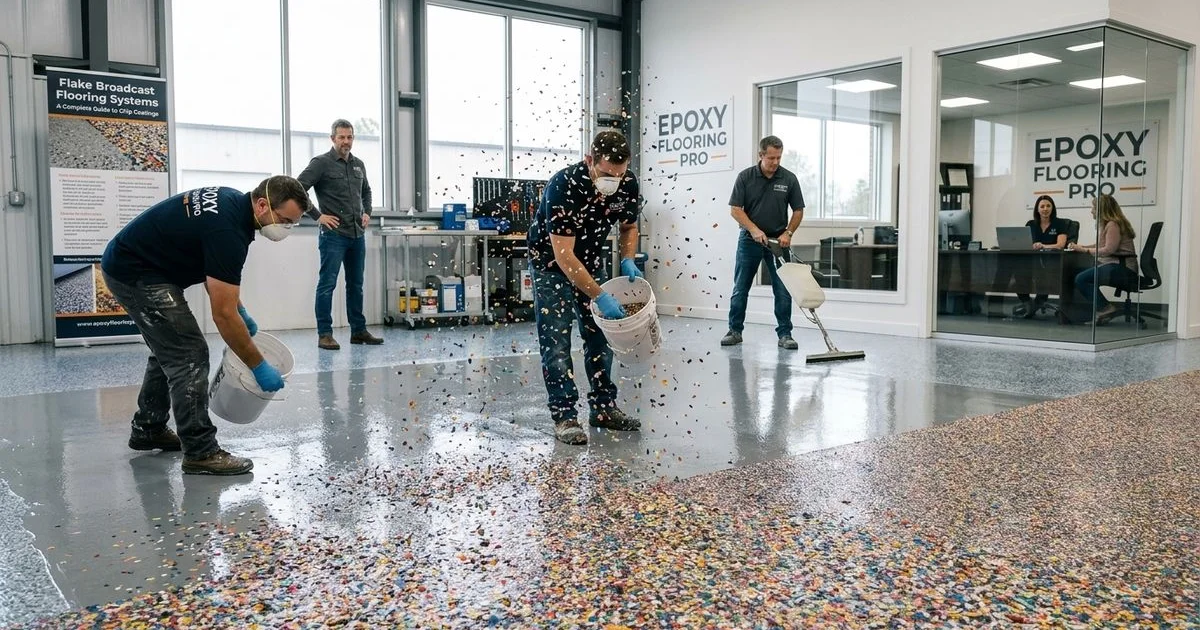
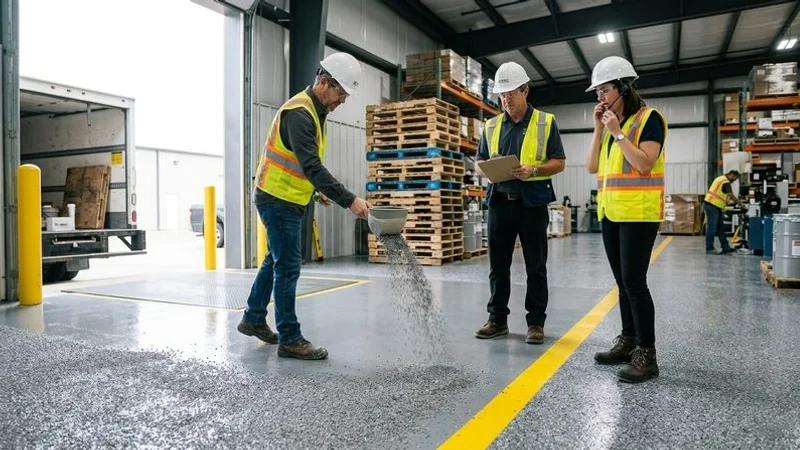
We achieve maximum slip resistance by employing a full broadcast application method. Installers throw the chosen aggregate into the wet coating material until the surface is entirely saturated.
Our crews ensure no visible coating remains between the particles during this crucial step. After the floor cures, technicians sweep away the loose excess aggregate.
We then apply a clear seal coat to lock the embedded particles firmly in place. This technique provides a thick, durable wear surface ideal for loading docks and heavy production zones.
Partial Broadcast
We utilize a partial broadcast method when facilities need moderate traction that is easier to mop. Technicians scatter the aggregate at a much lower density, intentionally leaving smooth coating visible between the particles.
Our clients find this surface much easier to maintain than a full broadcast floor. This method still delivers a meaningful improvement in slip resistance.
We commonly specify partial broadcasts for corridors that only experience intermittent wet conditions. It offers a highly effective compromise between safety and daily maintenance needs.
Integral Mix
We create a very subtle surface texture by mixing fine aggregate directly into the liquid coating prior to application. The installer distributes the aggregate uniformly throughout the coating film using a specialized roller.
Our integral mix floors improve traction without dramatically altering the appearance of the space. This technique works exceptionally well with lightweight polymer beads in retail environments.
We recommend this application for areas where heavy soil accumulation is not a primary concern. The embedded particles remain effective without collecting excess dirt over time.
Testing and Compliance Standards
Dynamic Coefficient of Friction (DCOF)
We measure slip resistance strictly using the current ANSI A326.3 Dynamic Coefficient of Friction (DCOF) test method. Industry professionals rely on a calibrated device called the BOT-3000E tribometer to conduct this precise evaluation.
Our technicians use this digital testing equipment because it accurately simulates human ambulation across a wet surface. The standard establishes a minimum acceptable DCOF of 0.42 for level, wet interior flooring.
We engineer our standard anti-slip systems to consistently test between 0.60 and 0.85 DCOF when wet. This performance range provides a substantial, verifiable safety margin well above the national baseline.
OSHA Compliance
We constantly remind facility managers that the OSHA General Duty Clause requires employers to mitigate recognized slip hazards. Floors that fail to meet the 0.42 DCOF threshold when wet clearly constitute a recognized hazard under federal guidelines.
Our regulatory reviews show that in 2025, OSHA increased the maximum penalty for serious safety violations to $16,550. Willful or repeated slip and fall hazards can now trigger massive fines up to $165,514 per violation.
We provide detailed documentation of slip resistance testing to help you prove compliance. Having this precise data on hand is an incredibly important tool during OSHA inspections.
The Cleanability Trade-Off
We acknowledge an inherent physical trade-off between aggressive slip resistance and daily cleanability. A deeper surface texture provides superior traction but creates more microscopic areas where bacteria and soil can hide.
Our specialists balance these two competing needs carefully in food & beverage flooring and healthcare environments. The solution lies in the precise specification of aggregate size, application density, and seal coat thickness.
We aim to achieve the target DCOF value without creating a floor that destroys mop heads or resists standard auto-scrubbers. Over-specifying heavy texture in an office corridor wastes money and forces the janitorial team into unnecessary manual labor.
Planning Your Slip-Resistant Industrial Flooring: Aggregate Options and Safety Standards
We understand that every industrial facility presents unique slip hazards based on its daily processes and traffic patterns. A thorough environmental assessment identifies the specific risk profile of each individual zone.
Our team specifies the exact aggregate system required to deliver optimal traction while keeping your maintenance costs manageable. Certified DCOF test documentation comes with every single anti-slip installation to solidify your compliance records. We focus on three main goals for every project:
- Enhancing daily worker safety
- Minimizing routine maintenance efforts
- Ensuring full federal regulatory compliance
We know proper planning prevents injuries, protects your workforce, and shields your business from severe regulatory fines.
Contact us today for a professional assessment to determine your ideal Slip-Resistant Industrial Flooring: Aggregate Options and Safety Standards.
Need Help With Your Floor Coating Project?
Our project managers provide free on-site assessments tailored to your facility.
Get a Free Estimate