You know how quickly a failing commercial floor can shut down an entire production line.
The downtime costs are often much higher than the price of the surface itself. Our team at Epoxy Flooring Pro specializes in high-performance industrial and commercial flooring solutions.
Facility managers need surfaces that can take a beating without looking worn out. We often recommend this specification because it solves three major facility headaches:
- Constant slip and fall hazards in wet environments.
- Chemical damage from aggressive cleaning protocols.
- Premature wear from heavy rolling equipment.
Quartz Flooring Systems: Texture, Durability, and Industry Applications represent the ideal middle ground. These systems easily outperform standard industrial epoxy coatings when you need heavy traction.
They also offer much better chemical resistance than purely decorative options like metallic epoxy. Our guide will break down exactly how these floors are built and where they work best in the US. Let’s look at the data to help you make the right choice.
What Is Quartz Broadcast Flooring?
This high-performance decorative coating system uses colored quartz aggregate broadcast into a resin matrix. The natural quartz granules provide exceptional slip resistance and a distinctive natural-stone aesthetic. We rely on industry-standard materials like Torginol 40-S broadcast grade quartz to ensure consistent sizing and color.
Consistent aggregate sizing is critical for meeting US safety regulations. The ANSI A326.3 standard requires a Dynamic Coefficient of Friction (DCOF) of 0.42 or higher for wet commercial spaces. Our quartz installations regularly achieve ratings well above 0.60 to meet stricter ADA recommendations.
A proper quartz system consists of several distinct layers working together. You cannot skip any of these steps if you want a floor that lasts:
- Penetrating Primer: Seals the raw concrete to prevent outgassing.
- Epoxy Body Coat: Acts as the adhesive layer for the aggregate.
- Quartz Broadcast: The Torginol mineral layer that provides impact resistance.
- Clear Topcoat: A protective urethane or polyaspartic seal that locks everything in place.
Why Quartz Outperforms Vinyl Flake in Demanding Environments
Both quartz and vinyl flake systems use broadcast aggregate in an epoxy or urethane base. The performance differences between natural quartz minerals and synthetic vinyl chips become obvious under heavy stress. We see vinyl floors fail quickly when exposed to extreme heat or sharp impacts.
Natural quartz registers at a 7 on the Mohs hardness scale. This makes it incredibly resistant to scratching from heavy equipment or dropped tools. Our team recommends quartz over vinyl anytime a US facility uses aggressive sanitation protocols.
| Property | Quartz Broadcast | Vinyl Flake |
|---|---|---|
| Hardness | 7 Mohs (very hard mineral) | Soft (flexible vinyl) |
| Slip Resistance | Excellent (exceeds 0.60 DCOF) | Good (depends heavily on topcoat) |
| Chemical Resistance | Superior (mineral is inert) | Good (vinyl can absorb some solvents) |
| Impact Resistance | High (mineral and resin matrix) | Moderate |
| Thermal Resistance | Good (withstands 250°F steam cleaning) | Limited (vinyl softens around 150°F) |
| Aesthetics | Natural stone appearance | Colorful pattern-based design |
| Cost per SF (US) | $6 to $10 | $4 to $8 |
How Quartz Systems Are Constructed
These floors are available in three distinct build configurations to match your specific traffic loads. Choosing the wrong thickness will lead to premature wear or wasted budget. We evaluate every concrete slab carefully before recommending a specific build.
Single-Broadcast System
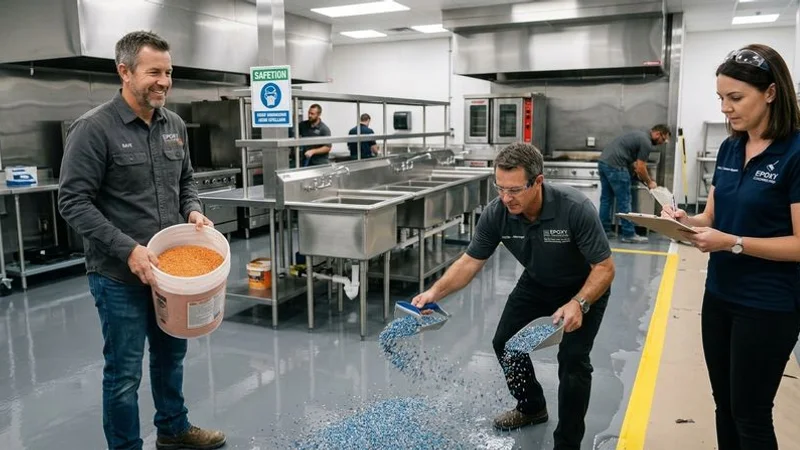
The single-broadcast configuration builds to approximately 1/8 inch (125 mils) in total thickness. This entry-level specification works well for moderate-duty commercial applications like retail spaces and office corridors. Our installers follow a precise five-step process to ensure proper adhesion:
- Penetrating epoxy primer applied to prepared concrete.
- Epoxy body coat applied at 12 to 16 mils.
- Colored quartz broadcast to full rejection (saturation).
- Excess quartz removed after the cure by scraping and vacuuming.
- Clear protective seal coat applied to lock in the texture.
Double-Broadcast System
The double-broadcast configuration builds to approximately 1/4 inch (250 mils) in total thickness. This is the standard specification for commercial kitchens, pharmaceutical facilities, and heavy-traffic hospital corridors. We apply a second layer of resin and aggregate to double the impact resistance:
- Penetrating epoxy primer.
- First epoxy body coat plus quartz broadcast to rejection.
- Excess removed, and a second epoxy body coat is applied.
- Second quartz broadcast to rejection.
- Excess removed, followed by a clear protective seal coat.
Advancements in topcoat technology have completely changed the installation timeline for these thicker systems. Products like Sherwin-Williams Accelera One allow for rapid curing between coats. Our crews can often return a floor to service for foot traffic in just two hours after the final application.
Troweled Quartz Mortar System
The troweled configuration builds to a massive 3/8 to 1/2 inch (375 to 500 mils) total thickness. Installers use specialized Torginol 25-A trowel grade quartz mixed directly into an epoxy mortar. We specify this heavy-build system for severely damaged concrete that needs serious resurfacing.
This thick mortar layer absorbs extreme point-loading from heavy manufacturing equipment or forklifts. It is highly effective in US industrial plants where standard coatings would simply crack under the pressure. Facilities dealing with failing floor coatings often benefit from this heavy-build approach as a permanent solution.
Quartz Color Blends and Design Options
Quartz granules are manufactured in a range of natural earth-tone colors that can be blended for visual depth. These blends help hide dirt and scuff marks between regular cleanings. Our clients appreciate that the natural mineral appearance reads as more permanent and refined than synthetic vinyl.
- Desert Sand: Warm tan and cream tones that create an inviting, clean appearance.
- Granite: Gray, white, and black particles that produce a sophisticated neutral palette.
- Autumn: Brown, tan, and rust tones that add warmth to commercial spaces.
- Arctic: White, light gray, and blue-gray tones engineered for clinical aesthetics.
- Custom Blends: Individual quartz colors mixed to match specific corporate branding.
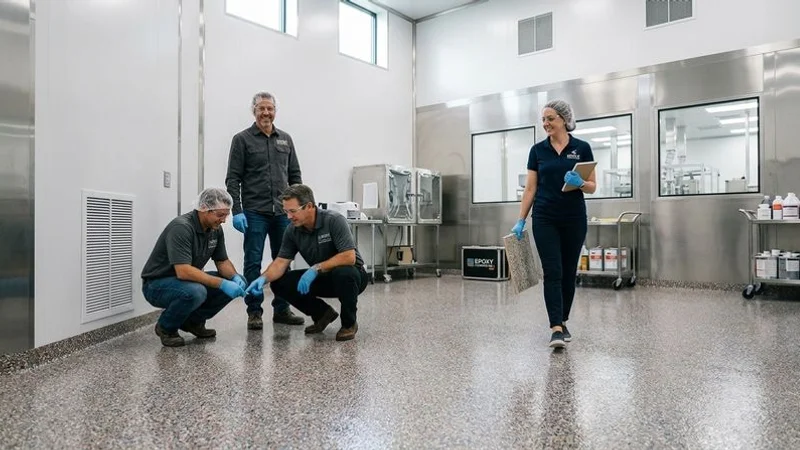
Color selection plays a major role in a facility’s lighting efficiency. Lighter blends like Arctic offer high Light Reflectance Values (LRV) that brighten up windowless manufacturing floors. We often use these lighter colors in US cleanrooms to help spot surface contaminants quickly.
Quartz Flooring Systems: Texture, Durability, and Industry Applications
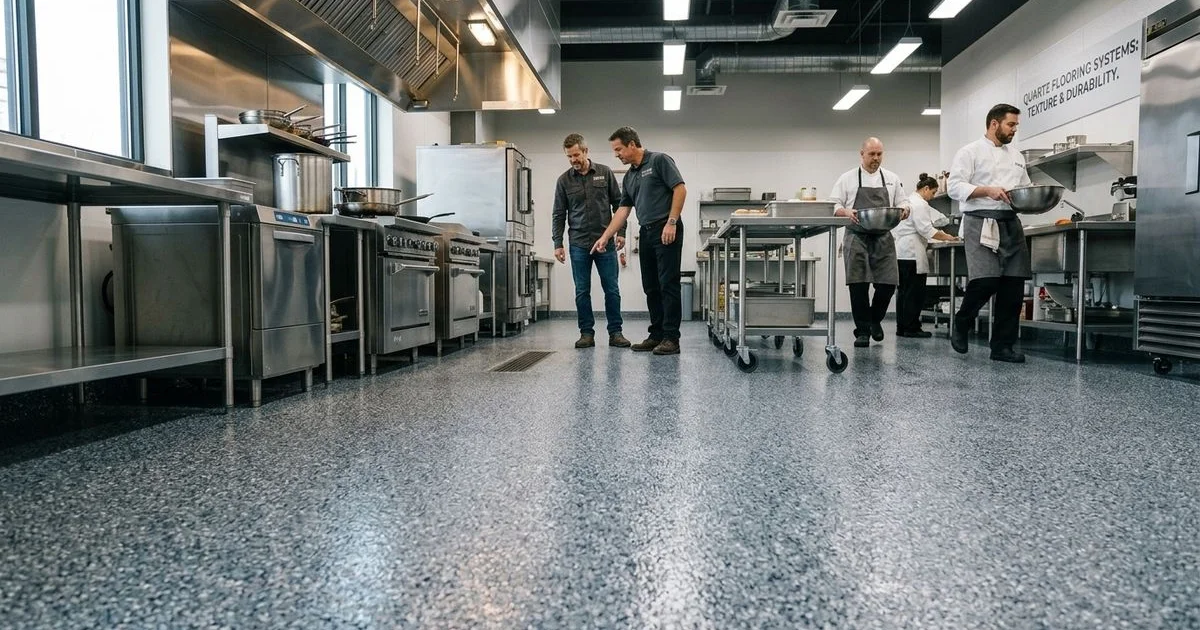
Commercial and Institutional Kitchens
Restaurant kitchens and food processing plants face intense regulatory scrutiny. The 2026 enforcement of the FDA Food Safety Modernization Act (FSMA) mandates strict preventive sanitation controls. We install seamless quartz systems designed for food & beverage flooring applications to eliminate the grout lines where dangerous bacteria like Listeria usually hide.
The angular quartz texture provides reliable traction in grease and water conditions that make smooth surfaces dangerous. These floors easily withstand the boiling water and aggressive degreasers used during daily washdowns.
Pharmaceutical Manufacturing and Clean Rooms
Pharmaceutical facilities require surfaces that are completely non-porous and chemically inert. Strict ISO 14644 standards dictate the allowable particle counts in these controlled environments. Our double-broadcast systems easily meet the requirements for ISO Class 5 cleanrooms by providing a monolithic, non-shedding surface.
Healthcare Facilities
Hospital corridors and clinical areas deal with constant, heavy rolling loads from medical equipment. The sheer weight of bariatric beds and loaded gurneys will easily crush standard commercial tile. We use quartz flooring to provide the necessary compressive strength while maintaining a clean, professional appearance in US medical centers.
School Cafeterias and Institutional Dining
High-traffic educational dining facilities face daily exposure to food spills, beverage stains, and aggressive cleaning schedules. Institutional flooring must maintain its slip resistance, appearance, and structural integrity year after year. We consistently see quartz systems deliver 15 or more years of reliable service in these demanding environments.
Restrooms and Locker Rooms
Constant moisture exposure and heavy foot traffic demand a flooring solution that is completely waterproof. Dropped weights and frequent chemical cleanings destroy traditional tile and grout very quickly. Our troweled mortar systems stand up to this abuse while providing an aggressive non-slip texture for wet bare feet.
Maintenance Requirements
These textured floors are incredibly low-maintenance by design. The granular surface naturally hides minor dust and soiling much better than a high-gloss smooth finish. We train facility teams to follow a simple, four-step cleaning protocol:
- Daily: Sweep or dust mop to remove loose grit and debris.
- Weekly: Damp mop or auto-scrub with an EPA-registered pH-neutral cleaner.
- Monthly: Deep clean with a walk-behind auto-scrubber using a soft-bristle brush attachment.
- Annually: Inspect the clear topcoat for wear patterns in high-traffic pivot zones.
The underlying mineral aggregate is virtually wear-proof and will last for decades. Long-term maintenance focuses entirely on the clear urethane seal coat that binds the surface together. Our teams typically recommend a simple topcoat re-application every five to ten years to maintain peak chemical resistance.
Specifying the Right Quartz System for Your Facility
Choosing the correct specification depends entirely on your chemical exposure profile and daily traffic intensity. Over-specifying wastes your capital budget, while under-specifying leads to a floor that fails within months. We take the time to evaluate your unique environment before making any recommendations.
The experts at Epoxy Flooring Pro provide customized solutions that balance hard performance data with your facility budget. Explore our decorative commercial flooring systems to see these finishes in action. You can also contact us directly for a site assessment and a comprehensive system recommendation.
Conclusion
Finding a durable flooring solution does not have to be a frustrating process. Quartz Flooring Systems: Texture, Durability, and Industry Applications prove that you can achieve both maximum safety and premium aesthetics.
Our experts are ready to help you upgrade your US facility with a surface that truly lasts.
Review your current maintenance budget and assess your slipping hazards today. Reach out to our team to schedule your detailed site inspection.
Need Help With Your Floor Coating Project?
Our project managers provide free on-site assessments tailored to your facility.
Get a Free Estimate