We hear the same question from plant engineers across the US every day.
You are likely asking about polished concrete vs. epoxy coatings: which floor system is right for your facility? A wrong choice easily leads to massive disruptions and thousands in wasted maintenance dollars.
Our team at Epoxy Flooring Pro is ready to cut through the marketing noise. Let’s look at the facts behind these two industrial flooring giants.
We will explore their chemical resistance, true life-cycle costs, and ideal use cases. Then, you can make a confident choice for your specific operational needs.
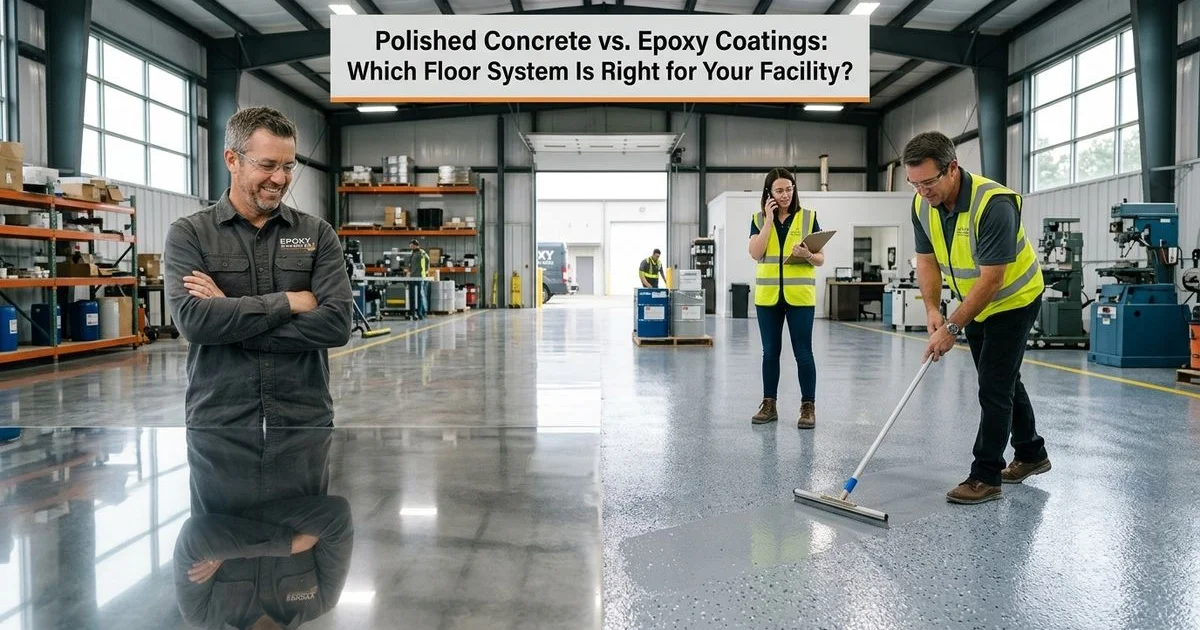
Polished Concrete vs. Epoxy Coatings: Which Floor System Is Right for Your Facility?
Polished concrete and epoxy coatings both transform raw concrete into durable surfaces. They achieve this through entirely different mechanical and chemical mechanisms. Understanding these specific differences helps you choose the right system.
The Mechanical Grinding Process
Our technicians describe polished concrete as a pure mechanical refinement. The process uses diamond-impregnated tooling to grind the concrete surface. This progressively hones the slab to finer levels of smoothness.
The concrete literally becomes its own finished surface. You do not apply any topical coating during this process. The raw floor simply transforms into a dense, polished slab.
The Polymer Film Approach
We approach epoxy coatings from an entirely different angle. These systems are polymer films applied directly on top of the concrete substrate. When resin and hardener mix, they undergo a chemical cross-linking process.
A standard hardware kit usually cures at a very thin 3 to 5 mils. Our US industrial installations range from 10 to 125 mils thick. This massive difference in film build provides the true protective barrier.
The finished surface is entirely epoxy, not the concrete itself. This fundamental distinction drives every difference in performance. It dictates your future maintenance routines, replacement costs, and facility suitability.
| Feature | Polished Concrete | Epoxy Coatings |
|---|---|---|
| Primary Mechanism | Mechanical surface grinding | Chemical polymer application |
| System Thickness | N/A (Surface modification) | 10 to 125+ mils (Industrial) |
| Finished Surface | The existing concrete slab | A protective synthetic film |
Durability and Wear Characteristics
Polished Concrete
Polished concrete hardness relies heavily on the original mix design. It also depends on the specific densifier treatment applied during the grinding phases. Our application of lithium silicate densifiers causes a specific chemical reaction.
This liquid reacts with free calcium to form a crystalline structure called calcium silicate hydrate. The resulting surface hardness increases by a verifiable 30 to 40 percent.
A thoroughly densified floor easily hits a Mohs hardness rating of 7 to 8. This puts it on par with natural quartz. Such extreme hardness makes the surface exceptionally resistant to daily abrasion.
It easily handles high foot traffic and standard rubber-tired vehicles. However, this mechanical hardness does not protect against dropped heavy objects or chemical staining.
Epoxy Coatings
Epoxy floor coatings act as a specialized sacrificial protective layer. They absorb daily abuse before any damage reaches the vulnerable concrete substrate below. We specify 100% solid epoxy and urethane flooring systems for heavy US industrial environments.
A proper industrial formulation delivers an impressive 10,000 to 14,000 psi in compressive strength. This actually makes the coating stronger than the concrete beneath it.
Standard applications of 12 to 20 mils handle moderate daily wear. For constant forklift traffic, current industrial standards require 40+ mils of thickness. This thick polymer structure absorbs massive impact force without cracking.
When the surface eventually shows signs of wear, a simple repair restores it. You can recoat the area without full removal if the base maintains good adhesion.
Common wear factors to evaluate:
- Forklift traffic: Requires 40+ mils for epoxy systems to survive.
- Dropped tools: Easily crack polished concrete but bounce off thick epoxy.
- Pallet dragging: Rapidly degrades thin, water-based coatings.
- Foot traffic: Polished concrete handles endless walking with zero degradation.
Chemical Resistance
This specific category is where the two flooring systems diverge the most. Chemical exposure dictates your choice more than any other single factor.
The Limits of Polished Concrete
Polished concrete offers virtually zero natural chemical resistance. Acids with a low pH around 2.5, like simple household vinegar, will instantly etch the surface. Our crews frequently repair polished floors destroyed by slow, unnoticed leaks.
Even minor petroleum spills leave dark, permanent stains deep in the pores. Prolonged exposure to alkaline substances will cause severe surface erosion over time.
You should never specify polished concrete in chemical processing areas. Even the best topical sealers cannot match the barrier protection of a true polymer coating.
The Superiority of Epoxy Coatings
Epoxy systems are chemically engineered to stop aggressive liquids. We rely on standard ASTM D1308 testing protocols to verify this resistance. This specific US test measures how a coating handles prolonged spot exposure to industrial chemicals.
A correctly specified system acts as a completely impermeable barrier. It stops hydraulic fluids, fuels, and industrial solvents from degrading your concrete structure.
For truly extreme environments, standard epoxy might not be enough. Our team upgrades facilities to specialized novolac epoxies in these severe cases. These highly cross-linked formulations resist concentrated acids and harsh caustics.
They provide the ultimate defense for secondary containment areas and battery processing plants.
Pro Tip: Always request ASTM D1308 spot test data for your specific facility chemicals before approving any flooring installation in a manufacturing environment.
Maintenance Requirements
Polished Concrete Maintenance
Polished concrete thrives on a very simple, consistent cleaning schedule. It requires daily dust mopping to remove abrasive dirt particles. You must also perform periodic wet cleaning using specific pH-neutral cleaners.
Our maintenance teams strictly avoid acidic cleaners on these surfaces. Harsh chemicals will rapidly strip the densifier and dull the brilliant shine. The primary advantage here is utter simplicity.
You do not need specialized equipment to keep the floor looking great. A standard auto-scrubber paired with clean water handles daily operations perfectly. However, you must re-treat the surface with a densifier every 2 to 5 years.
High-traffic zones will eventually require periodic re-honing to restore their original optical clarity.
Epoxy Coating Maintenance
Epoxy floors share similar daily cleaning requirements with polished concrete. They benefit immensely from daily dust mopping and routine wet scrubbing. We appreciate that epoxy is much more forgiving of aggressive industrial cleaners.
The completely sealed, non-porous surface naturally resists deep staining. You also never have to worry about applying densifier treatments.
According to current ISSA cleaning standards, seamless floors drastically reduce labor times. However, the coating will eventually wear down in high-traffic aisles. A busy warehouse running daily forklifts usually needs re-coating every 7 to 15 years.
This secondary application is significantly cheaper than the initial install. The existing base coat serves as an excellent substrate for the new material.
Essential maintenance tools for both systems:
- Standard microfiber dust mops for daily debris removal.
- Walk-behind or ride-on auto-scrubbers.
- Non-abrasive scrubbing pads to prevent surface scratching.
- Industrial pH-neutral cleaning solutions.
Cost Comparison
The initial price tag rarely tells the whole story in commercial construction. You have to factor in long-term maintenance, repairs, and facility downtime.
Polished Concrete
Polished concrete frequently wins the battle of initial installation costs. The current 2026 US average sits between $3.00 and $8.00 per square foot. This specific price depends heavily on the existing concrete condition and the desired gloss level.
Our estimators remind clients that extensive slab repairs will increase this baseline.
- Installation: $3.00 to $8.00 per square foot.
- Annual maintenance: $0.10 to $0.25 per square foot.
- Re-honing (every 3-5 years): $1.00 to $2.00 per square foot.
- 20-year life-cycle cost: $5.00 to $14.00 per square foot.
Epoxy Coatings
Epoxy systems require a slightly higher upfront capital investment. A standard commercial system costs $4.00 to $12.00 per square foot. We see prices scale higher for thick, chemical-resistant industrial systems.
You must also budget an additional $1.50 to $3.50 per square foot if old flooring removal is required. Polished concrete often appears cheaper on day one.
The true life-cycle comparison is much closer and depends entirely on your operating environment.
- Installation: $4.00 to $12.00 per square foot.
- Annual maintenance: $0.08 to $0.20 per square foot.
- Re-coating (every 7-15 years): $2.50 to $5.00 per square foot.
- 20-year life-cycle cost: $6.00 to $17.00 per square foot.
Ideal Applications for Each System
Choosing the right floor directly impacts your daily operations and regulatory compliance. Here is a straightforward guide to making the correct specification.
Choose Polished Concrete When:
Polished concrete shines in dry, stable environments. We frequently install this system in large logistics hubs and commercial retail spaces.
- The facility has minimal chemical exposure (retail, office, warehouse storage).
- Aesthetic appeal is a priority, particularly the natural stone-like appearance.
- The concrete substrate is in good condition with a quality mix design.
- Low long-term maintenance cost is more important than chemical protection.
- The space has natural light that showcases the reflective finish.
Choose Epoxy Coatings When:
Epoxy is the undisputed king of highly regulated environments. For example, the FDA Food Code Chapter 6 requires smooth, easily cleanable surfaces. Our specialized seamless epoxy systems meet these strict federal sanitation mandates perfectly.
Aerospace hangars also demand epoxy for its bright, highly reflective properties to easily spot dropped tools.
- The facility has regular chemical exposure (manufacturing, maintenance bays, processing).
- Chemical barrier protection of the concrete substrate is required.
- The concrete has defects, patches, or repairs that need to be concealed.
- Safety markings and color-coding need to be integrated into the floor system through OSHA floor striping.
- Custom colors or branding are desired in the floor finish.
Can You Combine Both Systems?
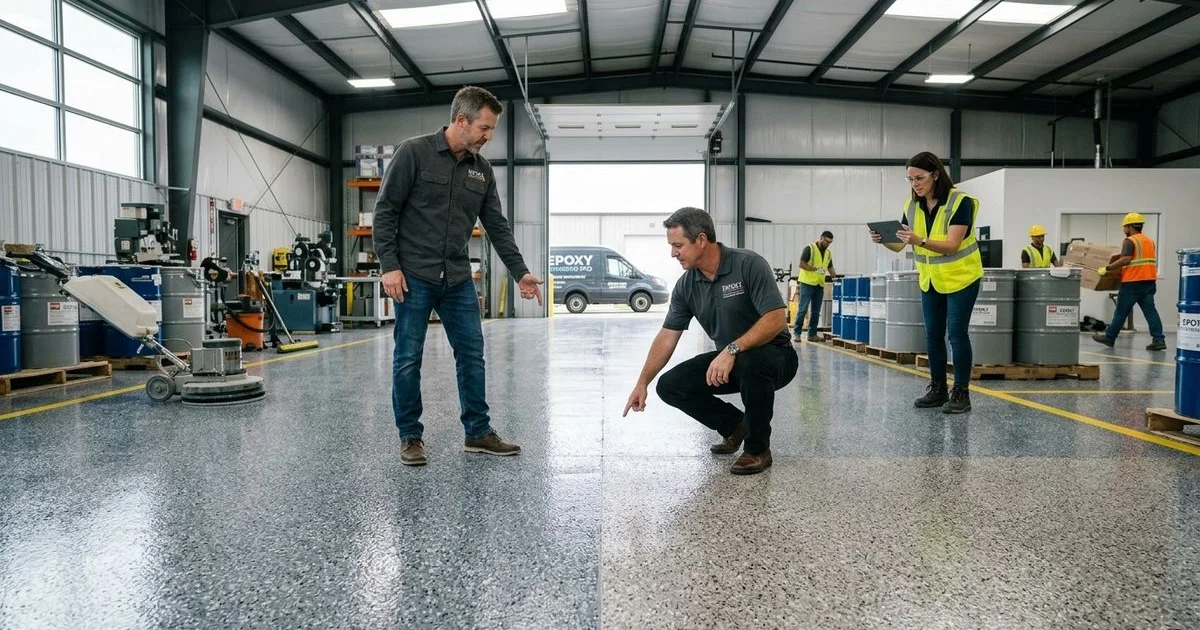
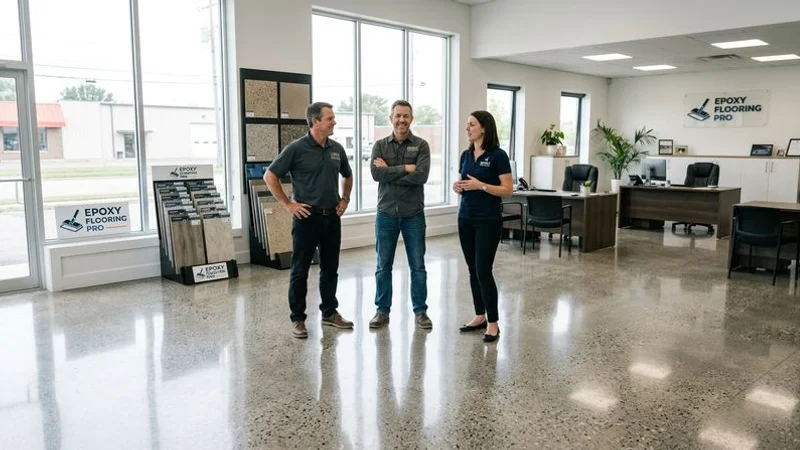
When deciding on polished concrete vs. epoxy coatings: which floor system is right for your facility, know that you can absolutely mix these solutions. Many smart facilities use a highly efficient zoned approach.
Polished concrete covers low-exposure areas like front offices, lobbies, and dry goods storage. Epoxy coatings protect the critical production lines, maintenance bays, and chemical storage areas.
Our team can evaluate your current facility and recommend the optimal floor system. A hybrid strategy optimizes your budget while delivering targeted performance exactly where needed.
We balance your strict performance requirements with realistic budget constraints. Take a moment to explore our polished concrete services today.
You can also contact us for a detailed site assessment customized to your specific operational needs.
Need Help With Your Floor Coating Project?
Our project managers provide free on-site assessments tailored to your facility.
Get a Free Estimate