We understand the core challenge of how to maintain polished concrete floors: a facility manager must balance heavy industrial traffic with strict cleaning budgets. That initial mirror-like gloss often fades much faster than expected.
A poorly maintained surface can lose its reflective properties within just a few years.
Our team knows that restoring a damaged finish requires expensive re-honing. Knowledge and consistency are the real difference-makers for long-term durability. Let’s examine the specific daily protocols, the exact equipment you need, and the common chemical mistakes to avoid.
How to Maintain Polished Concrete Floors: A Facility Manager Perspective on Why Maintenance Matters
We consider polished concrete to be one of the most durable commercial floor systems available in 2026. The lustrous sheen that makes this material so visually appealing is the result of a carefully refined surface structure.
Improper cleaning methods or harsh chemicals can easily degrade this hardened layer. Our maintenance data shows that a well-cared-for floor will retain its clarity and gloss for decades.
Neglected floors usually require a full resurfacing process that disrupts facility operations.
The American Society of Concrete Contractors notes that standard maintenance costs are fractions of a penny per square foot, while restorative grinding costs significantly more.
We consistently warn clients that prevention is cheaper than correction. Routine care preserves the calcium silicate hydrate bonds formed during the densification process.
Daily Maintenance Protocol
Dust Mopping
Daily dust mopping is the single most important maintenance activity for your facility. Our crews rely on high-quality tools like Rubbermaid Commercial Products heavy-duty microfiber dust mops.
Fine grit, sand, and particulate debris act as abrasives under foot and vehicle traffic. These particles scratch the polished surface and progressively dull the finish.
We strongly advise against oil-based dust mop treatments for two reasons:
- Oil leaves a sticky residue that attracts dirt.
- Synthetic treatments are a much better option for holding fine particles.
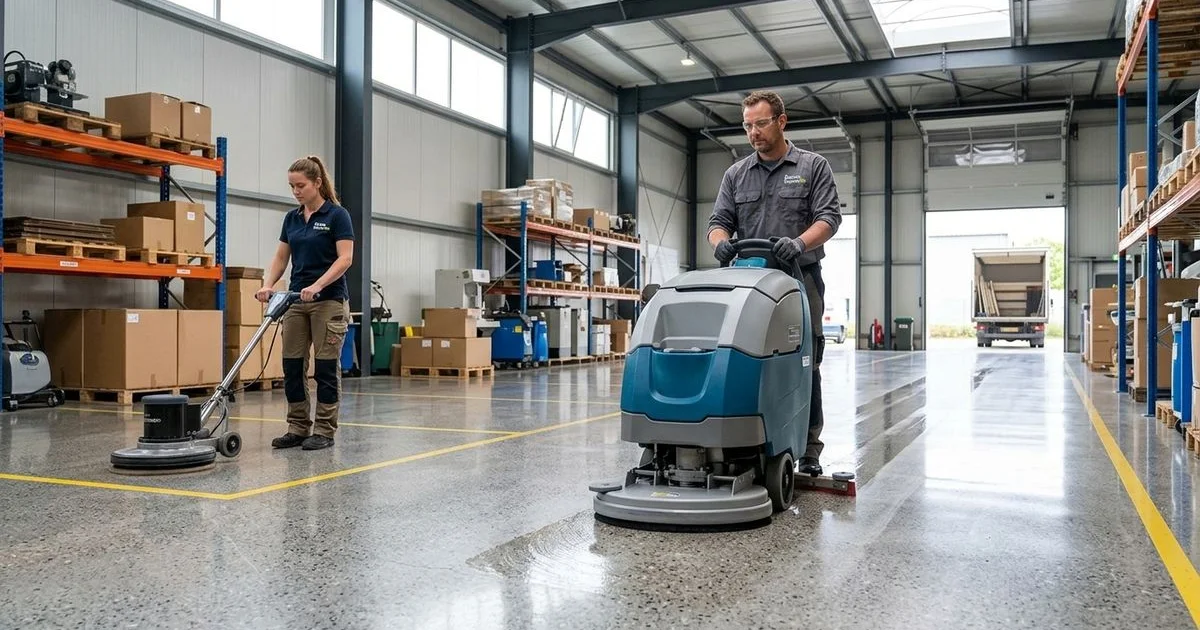
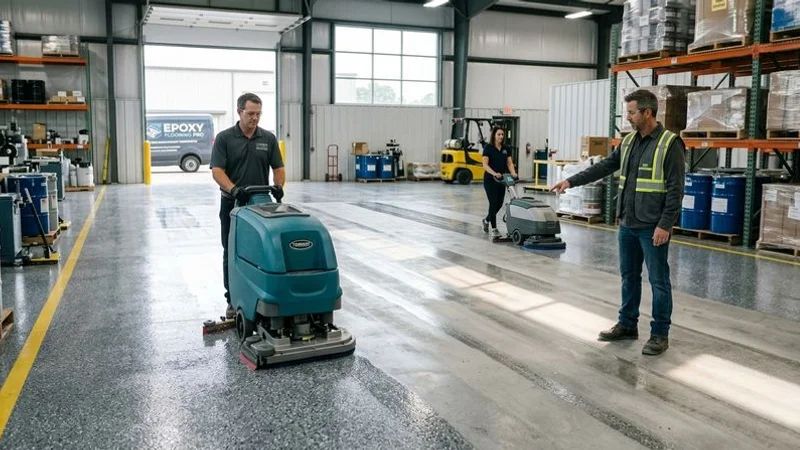
Our preferred method for large facilities is using an auto-scrubber in vacuum-only mode. Machines like the Tennant T300 cover large areas quickly without using water or chemicals. This dry-sweep approach captures the particulate before it can cause abrasive damage.
Spot Cleaning
We train janitorial staff to clean up spills immediately. Acidic substances such as coffee, soda, citrus juice, and vinegar are highly destructive. These liquids can etch the densified surface if allowed to dwell for extended periods.
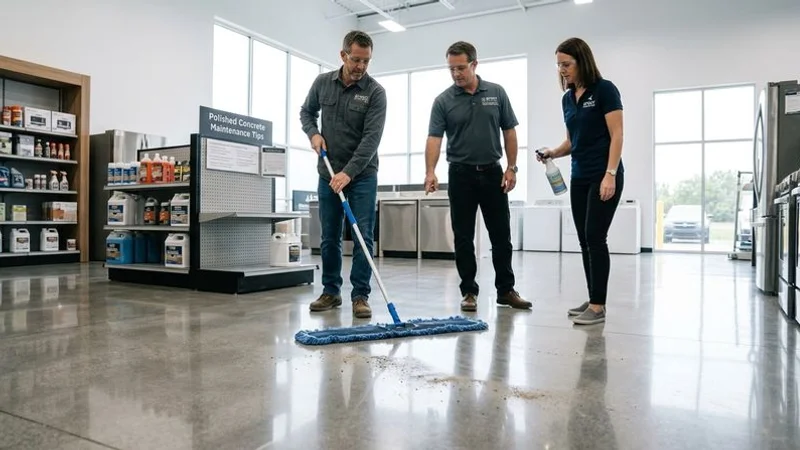
Our protocol requires blotting the spill with a clean cloth before following up with a damp mop. You must use a pH-neutral cleaner for this step. Oil or grease spills require applying an absorbent material immediately to prevent the stain from penetrating the surface pore structure.
We recommend removing the bulk of the spill and then cleaning the spot with a diluted alkaline degreaser.
Weekly Maintenance Protocol
Wet Cleaning
Weekly wet mopping or auto-scrubbing keeps the surface free of ground-in soil. This step maintains the surface clarity that daily dust mopping alone cannot achieve.
Our facility managers follow three critical rules for weekly wet cleaning:
- Use only pH-neutral cleaners formulated specifically for polished concrete.
- Products like Prosoco DailyKlean safely lift dirt while maintaining a neutral pH around 7.0.
- We avoid acidic cleaners because they attack the calcium silicate hydrate created during densification.
- Traditional soap-based cleaners leave a film that builds up over time and dulls the surface.
- Proper auto-scrubber squeegee pressure ensures dirty water is fully recovered from the floor.
Recommended Cleaning Equipment
Our equipment standards require an automatic floor scrubber for any facility over 5,000 square feet. This machine is essential for efficient and consistent wet cleaning. You need specific features to protect the concrete finish.
We look for the exact machine specifications below when selecting an auto-scrubber for the job.
| Feature | Purpose |
|---|---|
| Soft Nylon Bristles | Safe cleaning with red or white pads. |
| Adjustable Solution Flow | Prevention of surface over-wetting. |
| High-Performance Squeegee | Complete dirty water recovery. |
| Clean Water Rinse | Removal of residual neutral cleaner. |
Brown or black scrubbing pads are too aggressive for polished concrete. These harsh pads will immediately scratch and dull the surface finish.
Monthly and Quarterly Maintenance
Burnishing (Optional)
Our technicians often perform high-speed burnishing in high-traffic areas every month or quarter. This process uses a propane or electric burnisher running at 1,500 to 3,000 RPM. A diamond-impregnated maintenance pad, typically around 3000-grit, re-excites the surface structure.
We use burnishing to restore gloss in areas where foot traffic has started to create a dull pattern. This mechanical polishing is not a substitute for proper daily and weekly cleaning. It simply addresses the gradual gloss reduction that occurs naturally over time.
Guard Re-Application
Our crews know that stain-resistant guard treatments wear off gradually under heavy industrial traffic. Most commercial environments require guard re-application every 6 to 12 months in high-traffic zones. Moderate-traffic areas typically need a fresh coat every 12 to 24 months.
We apply high-quality products like Ameripolish 3D SP E to reinforce the stain protection. The application process requires following four clear steps:
- Clean the surface thoroughly.
- Apply the product evenly with a microfiber mop.
- Allow it to dwell for the specified time.
- Remove any excess before it dries.
You must work quickly to avoid uneven curing on the surface.
Common Maintenance Mistakes
Using Vinegar or Acidic Cleaners
Our team constantly warns clients against internet advice recommending vinegar as a natural floor cleaner. The acetic acid in vinegar has a pH level of around 2.4, which is highly destructive to concrete. This acid dissolves the calcium silicate hydrate crystals that give the floor its hardness and sheen.
We have seen repeated vinegar use progressively soften and ruin the polished layer.
Excessive Water
Polished concrete is highly water-resistant, but it is not completely waterproof. For environments with persistent moisture issues, a moisture vapor barrier system may be warranted.
Standing water can still penetrate into the pore structure over time.
Our cleaning crews always use the minimum amount of water necessary to get the job done. Complete water recovery with a high-quality squeegee vacuum is mandatory.
Wax or Acrylic Floor Finishes
You must never apply traditional wax or acrylic floor finishes to a densified surface.
We see these products create a sacrificial film that yellows and scuffs very quickly. The harsh stripping chemicals required to remove the wax will damage the polish underneath. The concrete maintains its own shine through its refined surface structure.
Neglecting Entrance Matting
Our most recommended maintenance tool is a proper entrance matting system. Walk-off mats at all entrances capture grit, sand, and moisture before they reach the interior floors.
The ISSA reports that 30 linear feet of matting can remove 100% of tracked-in debris.
We advise installing at least 10 to 15 feet of matting to catch 85% of contaminants, as recommended by the U.S. Green Building Institute. A short six-foot mat only removes about 40% of incoming dirt. Investing in longer mats dramatically reduces abrasive wear and lowers your cleaning costs.
When to Call a Professional
Our flooring experts step in when standard maintenance can no longer restore the finish. Even with excellent daily care, polished concrete eventually requires professional attention. Look for specific signs that your facility needs professional re-honing or re-polishing.
We typically look for the following damage indicators:
- Visible traffic patterns often indicate that high-speed burnishing cannot fix the dullness.
- Complete loss of reflective clarity in your main aisles is another major warning sign.
- We also identify chemical stains that have penetrated below the protective guard treatment.
- Deep surface scratches caused by dragged pallets or heavy equipment require immediate attention. Floors with extensive damage may need concrete & joint repair before re-polishing.
Professional re-honing usually starts at the 400-grit resin-bond diamond level.
Our process progresses through the original finish grit before applying new densifier and guard treatments. A simple hone and polish is significantly less expensive than a full restorative grind from coarse grit. This lighter process can also be completed with minimal disruption to your daily facility operations.
We know that proper planning prevents massive repair bills. Facility managers can rely on comprehensive maintenance programs to keep their floors looking perfect.
Learn more about our polished concrete services or contact us to discuss your exact maintenance needs.
We hope this resource on how to maintain polished concrete floors: a facility manager playbook, provides the clarity your team requires.
Need Help With Your Floor Coating Project?
Our project managers provide free on-site assessments tailored to your facility.
Get a Free Estimate