You know how a simple faded yellow line can be the difference between a smooth operation and a costly forklift accident. Faded lines cause confusion every single day. As experts at Epoxy Flooring Pro, we focus on delivering high-performance industrial flooring solutions with unmatched quality.
This experience shows us exactly what inspectors look for during a walkthrough.
From what we have seen, treating OSHA Floor Marking Standards as a mere suggestion is a massive risk. The rules dictate how pedestrians and heavy machinery interact.
We will break down the precise color codes every facility manager must know, the minimum line widths, and the best material choices. Let us look at the data and explore a few practical ways to protect your workers and pass your next inspection.
OSHA Regulatory Requirements
Clear visual communication is a strict legal requirement. Our teams constantly track federal updates to keep facilities compliant. For 2026, a serious OSHA violation carries a maximum penalty of $16,550. Willful or repeated safety failures can trigger fines up to $165,514 per violation. These financial penalties can devastate a maintenance budget instantly.
29 CFR 1910.22: Walking-Working Surfaces
OSHA General Industry standard 1910.22 requires that all walking-working surfaces remain clean, orderly, and sanitary. We often see facilities cited under this rule because their hazard zones lack proper definition.
According to the 2025 Bureau of Labor Statistics reports, walking-working surface violations and fall hazards remain among the top citations nationwide. Inspectors can issue fines starting at $11,823 just for the minimum willful violation under these general industry codes.
Specific floor marking requirements include:
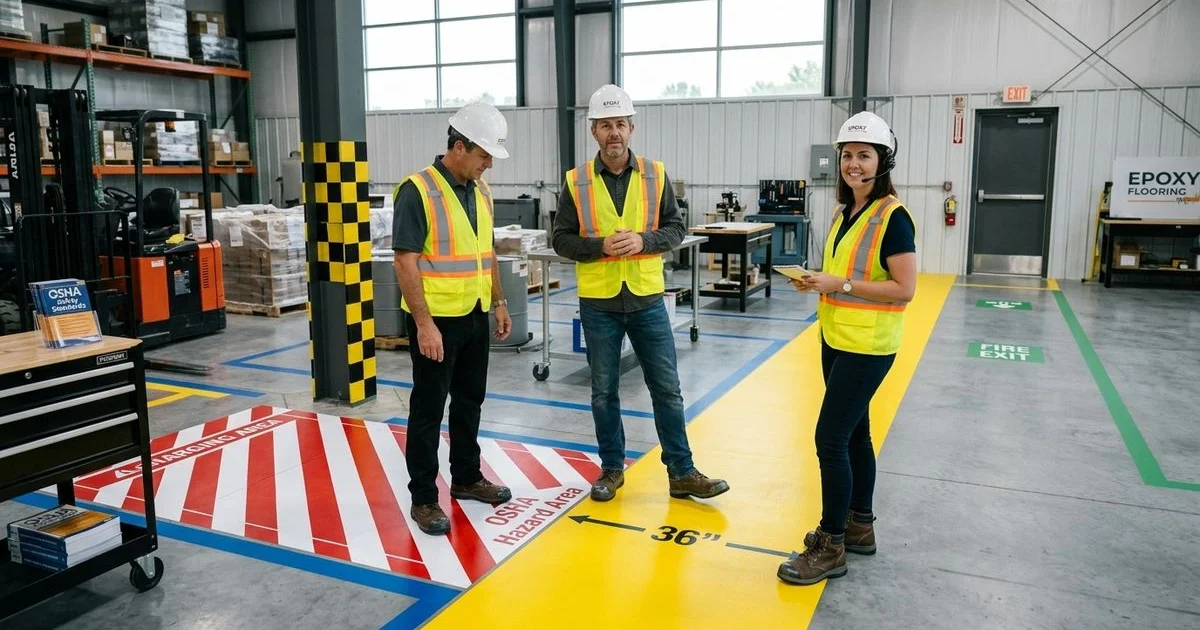
- Permanent aisles and passageways must be appropriately marked where mechanical handling equipment such as forklifts operates.
- Markings must be clearly visible and maintained in good condition throughout their service life.
- Floor holes and openings must be guarded, covered, or clearly marked.
- Exit routes must be clearly marked per OSHA 1910.37.
While OSHA does not dictate exact colors for every single application, inspectors evaluate lines against industry-recognized conventions.
ANSI Z535 Safety Color Code
The ANSI Z535.1 standard establishes the precise color assignments that safety professionals expect to see. Our experts strongly recommend following these exact hues to avoid confusing temporary contractors or new hires. A common pitfall is painting every line yellow.
Using yellow for everything creates visual fatigue, causing workers to eventually ignore the warnings.
| Color | Safety Meaning | Common Applications |
|---|---|---|
| Yellow | Caution | Pedestrian walkways, aisle boundaries, speed bumps, trip hazards |
| Red | Danger / Fire | Fire equipment zones, danger areas, stop lines, fire lanes |
| Orange | Warning | Machine perimeters, pinch points, electrical panel clearance zones |
| Green | Safety / First Aid | First aid stations, safety showers, eyewash stations, safe areas |
| Blue | Information / Mandatory | PPE-required areas, informational zones, mandatory action areas |
| White | Storage / General | Rack locations, equipment parking, production zones, staging areas |
| Yellow/Black | Physical Hazard | Bump hazards, low clearance warnings, tripping dangers |
| Red/White | No Entry / Fire Access | Fire lane keep-clear zones, restricted access areas |
Pro Tip: Keep your color palette strictly limited to these ANSI standards. Adding custom colors for specific departments usually leads to factory-wide confusion.
Line Width Standards and Specifications
Both ANSI and 5S methodology provide strict guidance on line widths for various applications. We find that skimping on tape width is the fastest way to fail an audit.
- 2 inches: This is the OSHA minimum for general aisle markings. These thin lines are virtually invisible to a forklift operator traveling at standard speeds of five miles per hour.
- 4 inches: This width serves as the industry standard for most industrial floor markings. Heavy-duty 4-inch tape costs between $0.40 and $1.00 per linear foot.
- 6 inches: We recommend this size for high-visibility pedestrian walkways in areas with heavy equipment traffic. These wide lines stand out perfectly in poor lighting or dusty environments.
- Corners: You should use the same width as straight sections with radius turns rather than sharp angles. Sharp tape corners snag on pallets and quickly peel away.
5S Floor Marking Best Practices
Facilities implementing lean manufacturing rely heavily on visual cues. The five principles of Sort, Set in Order, Shine, Standardize, and Sustain require a clear framework on the ground.
Equipment Shadow Marking
Mark designated parking positions for pallet jacks, cleaning equipment, and mobile carts. Outline markings show exactly where each item belongs when not in use. We suggest using pre-cut heavy-duty vinyl shapes from brands like Mighty Line for this task.
These 50-mil thick corner markers survive direct pallet scrapes much better than standard paints. The specific shapes make it immediately obvious when a critical tool is missing.
Color-Coded Zone Management
Assign consistent colors to functional zones throughout the entire building. Raw material storage, quality hold areas, and rework zones must have distinct color boundaries. Every single employee should identify these zones without asking a supervisor.
A common mistake is using safety green or informational blue for scrap areas. You must stick to white or gray for general production boundaries to keep safety colors distinct.
T-Markings and L-Markings
Use T-shaped and L-shaped corner markers for pallet positions and material staging areas. Our installation crews prefer these because they are faster to apply and easier to maintain.
Data shows that L-markings consume roughly 60% less material than full rectangular outlines. This approach provides the exact same visual reference while cutting your material budget in half.
Traffic Flow Management
Uncontrolled movement patterns cause severe injuries every day. In the United States, roughly 11% of all operational forklifts are involved in an accident each year. Pedestrians tragically account for 36% of forklift-related fatalities. Addressing slippery industrial floors alongside proper markings creates a comprehensive safety program.
Directional arrows in forklift aisles establish predictable and safe traffic patterns. Intersection markings with stop lines physically force drivers to pause and look. You can prevent head-on collisions simply by painting clear, one-way traffic lanes.
Floor Marking Material Options
The durability of your safety language depends entirely on the material you select. We always evaluate the specific traffic load before recommending a product.
Epoxy Paint Markings
Epoxy paint delivers superior performance in moderate to heavy traffic areas. Professionally applied epoxy paint costs between $0.50 and $1.50 per linear foot. This material bonds exceptionally well to epoxy-coated floors and is available in all standard safety colors.
We regularly see these durable coatings last 5 to 10 years before needing replacement. When applied over a properly installed epoxy and urethane flooring system, this makes epoxy paint the most cost-effective option for permanent industrial layouts.
Floor Marking Tape
Pressure-sensitive adhesive tape provides the fastest installation of any marking method. Standard vinyl tape is very thin, typically 6 to 10 mils, and lasts up to 18 months. Heavy-duty industrial tape measures 20 to 50 mils thick and withstands pallet dragging much better.
Our clients often use tape for initial 5S layouts or temporary configurations. Service life is typically 1 to 3 years before edges begin lifting under forklift traffic.
Thermoplastic Markings
Heat-applied thermoplastic markings melt directly into the floor surface during application. This creates an extremely durable bond that can last 5 to 10 years in harsh conditions. Thermoplastic requires specialized heating equipment.
We typically reserve this heavy-duty option for permanent high-traffic forklift aisles.
Maintaining Your Floor Markings
Even the highest quality materials require ongoing maintenance to remain compliant. Our maintenance teams use a strict schedule to catch problems early.
- Monthly visual inspection: Walk the facility and note any faded, chipped, or peeling markings.
- Quarterly touch-up: Replace worn tape sections or repaint faded lines before they become unreadable.
- Annual comprehensive audit: Verify all markings match the current 2026 layout and update for any equipment relocations.
Insider Warning: Forklift operators who turn their wheels while stationary will instantly destroy even the strongest floor tape. This pivoting action grinds the adhesive off the concrete.
A great patch-and-go tactic for tape is simply cutting out the damaged section with a utility knife. You can drop in a new piece in five minutes. Missing markings are an immediate red flag to inspectors because they clearly show a neglected safety program.
Planning Your Floor Marking Project
Whether you are installing visual boundaries for the first time or upgrading to permanent epoxy, proper planning is essential. We provide complete layout design and installation services to eliminate the guesswork. The process ensures your entire facility meets the latest safety guidelines.
Our team will verify every measurement and color choice. Explore our OSHA floor striping and safety marking services or contact us for an assessment customized to your operations.
Your safety lines must protect your team and your bottom line.
Need Help With Your Floor Coating Project?
Our project managers provide free on-site assessments tailored to your facility.
Get a Free Estimate