We at Epoxy Flooring Pro have seen flawless epoxy finishes hide a costly secret on commercial job sites across the US. Moisture migrating through concrete slabs from the soil below causes more coating failures than any other single factor.
The concrete surface may look and feel perfectly dry. Standard moisture meters reading the surface might even show acceptable levels.
But below the surface, water vapor is moving.
Our experience shows this vapor travels through the capillary network at rates high enough to destroy impermeable coatings. This guide on Moisture Vapor Transmission Testing: Why Your Floor Coating Failed (and How to Prevent It) explains how this invisible threat works.
You will learn exactly how to protect your next flooring investment.
Moisture Vapor Transmission Testing: Why Your Floor Coating Failed (and How to Prevent It)
You have likely witnessed the destructive power of moisture vapor transmission (MVT) if you have ever seen an epoxy floor coating blister or delaminate in large sheets. This invisible force is the leading culprit behind commercial flooring disasters.
Industry data from 2026 shows that 80 percent of all epoxy failures stem from poor concrete surface preparation and undetected moisture.
We see this problem amplified in humid environments like coastal regions. In areas like South Florida, nearly one in three floor coatings fail within 18 months due to unmanaged water vapor.
Our teams look for several hidden factors that cause these failures:
- Deceptive Surface Conditions: The top of the concrete often feels completely dry to the touch.
- Capillary Action: Water vapor moves continuously through the microscopic network inside the slab.
- Trapped Pressure: Applying an impermeable layer seals the vapor inside and generates destructive force.
This understanding is essential for any facility manager planning a floor coating project.
How Moisture Vapor Destroys Floor Coatings
Concrete is not a waterproof barrier. It functions more like a hard, porous sponge filled with an interconnected network of capillary channels. Moisture from the ground migrates upward through these capillaries as a vapor in slabs on grade.
This vapor escapes harmlessly into the ambient air when the surface remains open and uncoated.
Our application specialists know exactly what happens when you apply an impermeable coating like an industrial epoxy. The vapor can no longer escape, so it accumulates at the concrete and coating interface.
This accumulation generates hydrostatic pressure that literally forces the coating away from the substrate. During humid summer months, concrete can release up to 30 percent more trapped water vapor.
Here is how the destruction typically progresses:
- Initial Blistering: Small bubbles form in low-lying areas or near exterior walls.
- Osmotic Action: Moisture draws soluble salts to the surface, weakening the chemical bond.
- Coalescence: Small blisters grow and merge together.
- Total Delamination: Entire sections of the coating detach from the concrete.
We frequently see extreme weather cycles compound the problem in northern US states. Winter frost drives the moisture deeper into the slab, and spring thaws release concentrated bursts of vapor upward.
ASTM Testing Methods for Moisture Vapor
ASTM F2170: Relative Humidity Testing
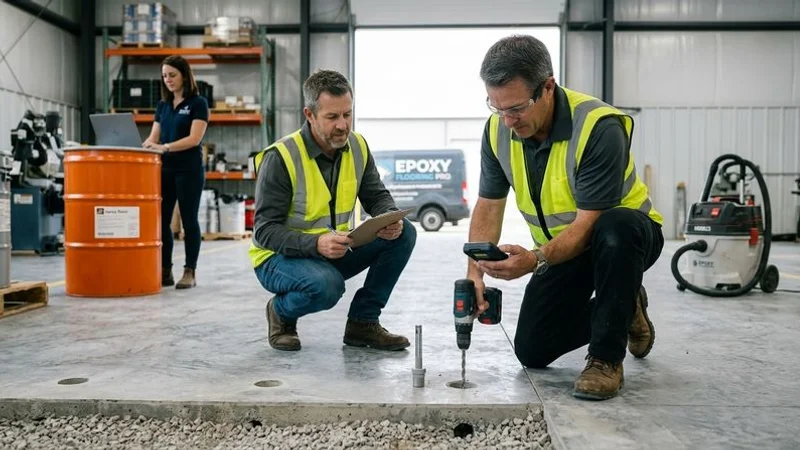
The ASTM F2170 in-situ relative humidity test remains the most accurate and widely specified method for measuring moisture conditions. This test measures relative humidity at a depth of 40 percent of the slab thickness for concrete drying from one side.
This depth represents the exact moisture condition that will exist at the coating interface after you seal the surface.
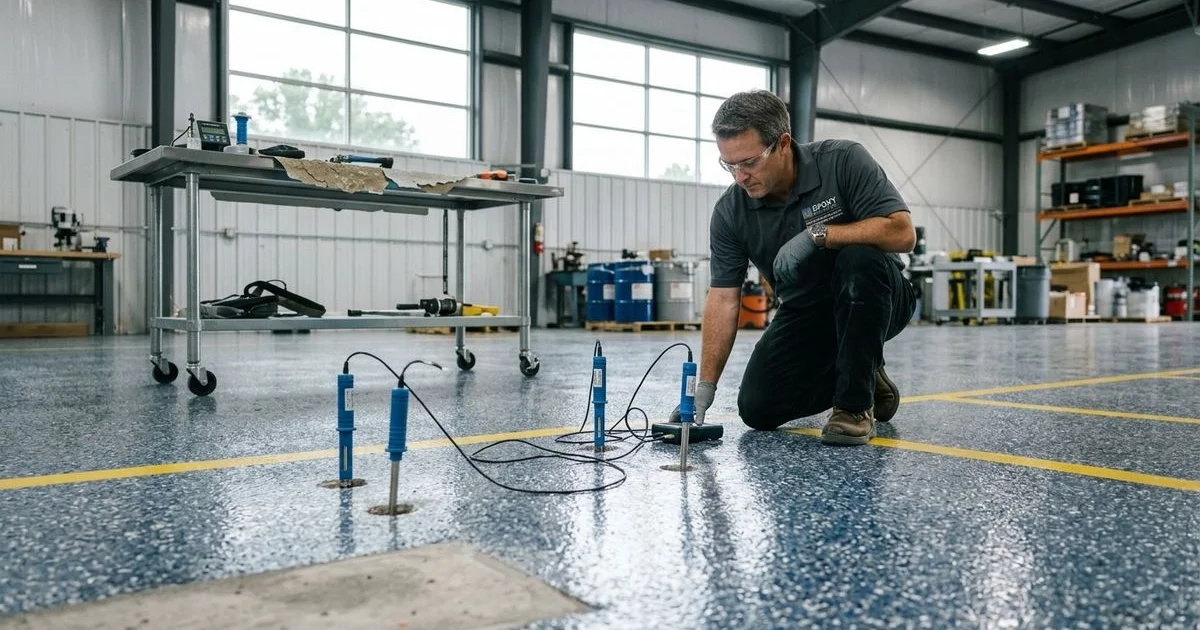
Our technicians rely on advanced equipment like the Wagner Meters Rapid RH L6 Starter Kit for this process. These kits cost around $890 in the US for 2026 and provide highly reliable data.
The modern testing procedure involves several precise steps:
- Drilling holes into the concrete at the specified 40 percent depth.
- Installing NIST-traceable relative humidity smart sensors into the holes.
- Allowing the probes to equilibrate for a strict minimum of 72 hours.
- Using an app like the DataMaster L6 to wirelessly record the relative humidity readings.
Most epoxy coating manufacturers require relative humidity readings below 75 percent RH. Some specialized moisture-tolerant systems allow up to 85 percent RH.
We always mandate moisture vapor barriers before coating if readings rise above the manufacturer’s maximum threshold. The onboard memory of these modern sensors stores up to 512 time-stamped measurements to ensure verifiable warranty compliance.
ASTM F1869: Calcium Chloride Testing
The ASTM F1869 calcium chloride test measures the rate at which moisture vapor escapes from the concrete surface. The industry expresses this rate as pounds of moisture per 1,000 square feet per 24 hours.
This test served as the standard for decades, and the current ASTM F1869-23 version remains widely used today.
We must note that this method has significant, known limitations. It only measures moisture in the top half-inch of the slab, and the results are easily influenced by ambient room temperature and airflow.
The testing procedure involves:
- Preparing a clean, bare concrete area of at least 20 square feet.
- Placing a pre-weighed container of anhydrous calcium chloride on the surface.
- Sealing the container tightly under a plastic dome.
- Waiting 60 to 72 hours for the absorption process.
- Re-weighing the calcium chloride to calculate the moisture vapor emission rate.
Most coating manufacturers require calcium chloride test results below 3 pounds per 1,000 square feet per 24 hours. Results between 3 and 5 pounds may be acceptable with moisture-tolerant primer systems.
Our installers typically recommend dedicated moisture mitigation systems if results land above the 5-pound mark. This test is also specifically excluded from use on lightweight aggregate concrete.
Which Test Should You Use?
The F2170 relative humidity test is highly preferred for modern commercial projects because it measures conditions deep within the slab. Surface conditions change rapidly based on ambient humidity, recent cleaning, or superficial contamination, making calcium chloride results significantly less reliable.
We typically perform both tests at multiple locations to build the most complete moisture picture of your slab. Using them together provides a comprehensive assessment for complex or high-risk installations.
Here is a clear comparison of how the two tests differ in practical application:
| Feature | ASTM F2170 (Relative Humidity) | ASTM F1869 (Calcium Chloride) |
|---|---|---|
| Measurement Target | Internal slab moisture at 40% depth | Surface vapor emission rate |
| Primary Metric | Percentage (%) of Relative Humidity | Pounds per 1,000 sq. ft. per 24 hrs |
| Vulnerability | Highly stable and predictive | Influenced by ambient temperature and airflow |
| Warranty Status | Required by most major manufacturers | Often rejected as a standalone metric |
| Best Used For | New construction and critical installations | Initial screening on legacy projects |
This combined testing approach prevents costly warranty voidances and keeps your project on schedule.
When Is Moisture Testing Required?
Moisture testing is an absolute requirement for every single slab-on-grade installation before applying any impermeable coating. The ASTM F710-22 standard clearly outlines the necessity of these evaluations to determine a concrete slab’s suitability for resilient floor coverings.
Our testing protocols apply strictly to several specific scenarios:
- New Construction Slabs: Even modern buildings with vapor barriers installed beneath the slab require verification.
- Existing Problem Slabs: Any surface where previous coatings have exhibited blistering or peeling needs immediate evaluation.
- Unknown Barrier History: Older facilities built before the 1990s rarely feature an intact vapor barrier meeting modern ASTM E1745 criteria.
- High Water Table Zones: Geographic areas with heavy rainfall or coastal proximity demand rigorous checks.
Elevated slabs over occupied, climate-controlled spaces generally do not require extensive moisture testing because there is no ground moisture source below.
We always advise testing slabs positioned over unconditioned spaces like parking garages or crawl spaces. Condensation and humidity can still wreak havoc in these specific environments.
Moisture Mitigation Options
Moisture-Tolerant Primers
Specialized 100 percent solids epoxy primers can bond securely even in the presence of elevated moisture. These advanced formulations accommodate vapor transmission rates up to 15 to 25 pounds per 1,000 square feet per 24 hours.
These primers create a semi-permeable barrier that allows moisture to diffuse slowly through the primer matrix. This controlled diffusion prevents the concentrated hydrostatic pressure that causes catastrophic delamination.
Our installation teams often utilize these fast-curing primers to keep fast-paced manufacturing projects on schedule. They act as a reliable insurance policy against unexpected humidity spikes.
Crystalline Moisture Barriers
Cementitious crystalline treatments penetrate deep into the concrete pore structure. They react with free lime and moisture to form insoluble crystals that physically block water passage through the capillary network.
These treatments are highly effective for moderate moisture levels. They also possess the unique advantage of becoming stronger over time, as any new moisture simply activates additional crystalline growth.
We recommend crystalline barriers for older concrete slabs where surface grinding might expose a highly porous network. They provide a structural level of defense before the decorative epoxy layers are applied.
Epoxy Moisture Barriers
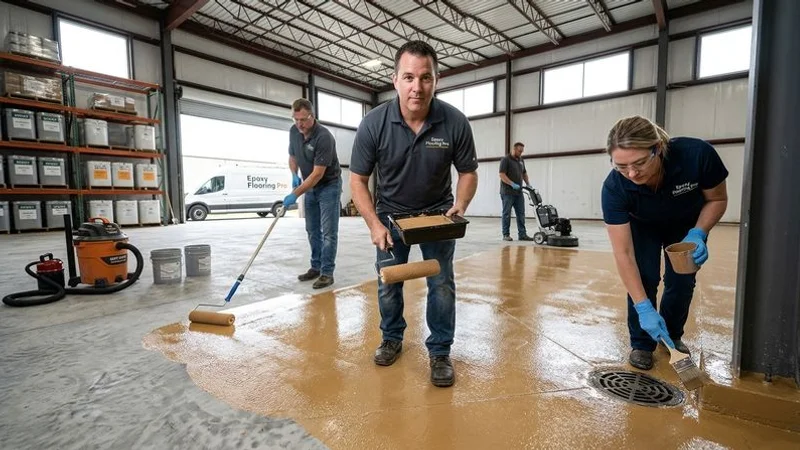
Two-component epoxy moisture barrier systems create an impermeable, heavy-duty film over the concrete surface. These systems are typically applied at a thickness of 10 to 20 mils before the primary floor coating system goes down to resist extreme moisture transmission.
Our recent 2026 pricing data shows these premium barriers add between $1.00 and $5.00 per square foot to project costs in the US. The exact price depends heavily on the amount of preparation required, including:
- Extensive diamond grinding to open the concrete pores.
- Thorough crack and joint repair using specialized mortars.
- Addressing extreme hydrostatic pressure variations.
Investing in this barrier is essential for spaces with severe moisture issues. Skipping this step is the fastest way to guarantee a premature flooring failure.
The Cost of Ignoring Moisture
Skipping moisture testing to save a few days and a small amount of money is a dangerous false economy. Many contractors learn this lesson the hard way when a newly installed floor begins to peel within a year.
The upfront cost of professional moisture testing for a typical 20,000-square-foot commercial facility ranges from $1,500 to $3,000.
We contrast that small investment against the devastating cost of a complete coating failure. Removing the failed epoxy, mitigating the moisture, and completely re-coating the same area typically ranges from $150,000 to $300,000.
Consider the true total cost of ownership for your flooring:
- The Unprepared Approach: Rushing the job and skipping moisture vapor barriers leads to total failure in 12 to 18 months.
- The Professional Approach: Properly tested and mitigated floors deliver 15 to 20 years of continuous, reliable performance.
- The Hidden Expenses: Failed floors also cause massive operational downtime, lost productivity, and potential safety hazards for employees.
Our standard operating procedure includes rigorous moisture testing as a mandatory part of every pre-installation assessment. The installation team simply will not apply an industrial coating system until the internal slab conditions fall strictly within acceptable parameters.
Understanding Moisture Vapor Transmission Testing: Why Your Floor Coating Failed (and How to Prevent It) ensures your new floor will look great and perform perfectly for decades.
Learn more about our concrete assessment and repair services or contact us to schedule precise moisture testing for your facility before your next coating project.
Need Help With Your Floor Coating Project?
Our project managers provide free on-site assessments tailored to your facility.
Get a Free Estimate