You know how a single audit finding can derail a whole week of production.
Our team at Epoxy Flooring Pro has watched improper surface choices turn routine inspections into massive compliance nightmares. The stakes are higher than ever right now. The average cost of a U.S. food recall reached $10.2 million in direct expenses in 2025.
That figure ignores the permanent damage to your brand reputation.
Let’s look at the data, what it is actually telling us, and then explore a few practical ways to respond. I will break down exactly how to pass HACCP & OSHA audits with the right food processing flooring. Then, I will walk you through the systems that guarantee a passing grade.
Why Flooring Is a Critical Control Point in Food Safety
In food processing facilities, the floor is not just a surface you walk on. It is an active, critical component of your entire food safety management system. HACCP auditors evaluate flooring as a primary source of contamination. OSHA inspectors assess the exact same area for slip, trip, and fall hazards.
A floor system that fails to meet regulatory requirements causes severe problems. You risk audit citations, production shutdowns, and devastating product recalls. The financial liability is staggering for facilities that ignore this.
In 2026, the maximum penalty for a willful or repeated OSHA violation jumped to $165,514. Even a single serious slip and fall hazard citation can cost you up to $16,550. Understanding exactly what auditors look for eliminates these financial risks entirely.
HACCP Flooring Requirements
The Hazard Analysis Critical Control Points framework does not prescribe specific flooring brands. Instead, it establishes strict performance criteria that your floor system must meet.
Cleanability
The floor must be easily cleaned and sanitized. It cannot harbor bacteria in cracks, joints, or surface imperfections.
This means the surface must be completely seamless and non-porous. It must also resist the harsh cleaning chemicals used in your daily sanitation protocol.
Concrete alone fails this requirement completely due to a few structural flaws:
- It is highly porous and absorbs wastewater.
- It traps organic matter deep within the slab.
- It degrades rapidly when exposed to acidic food byproducts.
We highly recommend verifying your floor’s cleanability using ATP (Adenosine Triphosphate) swab testing. Auditors look for results under 10 Relative Light Units (RLU) to confirm a surface is truly sanitary.
Your floor system must withstand daily exposure to aggressive sanitizers. Facilities typically use peracetic acid (PAA) at 60 to 80 parts per million.
This chemical destroys biofilms but will also eat away at improper coatings. Any floor system in a HACCP-regulated area must provide a continuous, impervious shield over the concrete substrate.
Durability Under Sanitation Protocols
Food processing sanitation protocols are exceptionally aggressive. Hot water wash-downs regularly hit 180 degrees Fahrenheit. Caustic cleaning solutions at pH 12 or higher destroy most standard floor coatings within months.
The floor system must maintain its integrity and surface properties under daily exposure. Coating failures that expose the concrete substrate beneath create immediate sanitation hazards.
Our installers frequently see standard epoxy systems fail in wet environments due to thermal shock. This happens because standard epoxy and the concrete beneath it expand and contract at different rates.
“A sudden temperature shift causes standard coatings to snap and delaminate, creating an immediate breeding ground for bacteria beneath the surface.”
You can prevent this failure by selecting materials with a coefficient of thermal expansion that closely matches concrete.
Slope to Drain
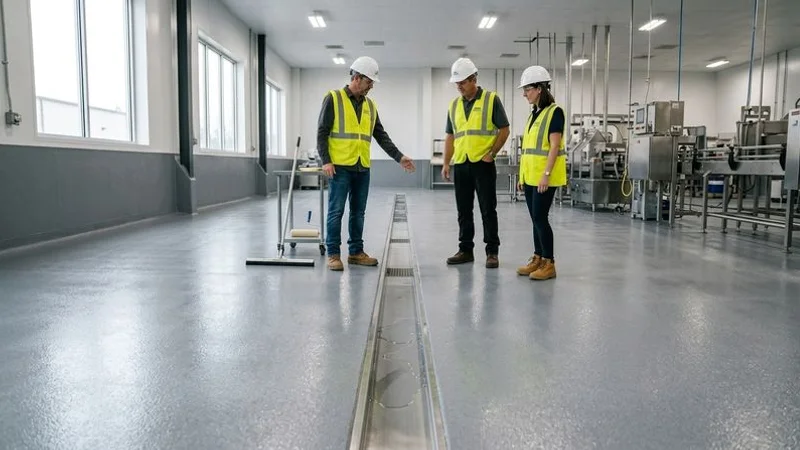
Standing water on processing floors is a major contamination risk. HACCP requirements dictate that floors must slope to the drain.
You need a minimum slope of 1/8 inch per foot in wet processing areas. Dry processing areas require a minimum slope of 1/16 inch per foot.
The SQF Edition 9 Food Manufacturing code specifically mandates that wastewater must discharge directly to the floor drainage system. Standing water is a notorious breeding ground for Listeria. Proper slope is a non-negotiable safety feature.
The floor coating system must be compatible with these slope corrections. Urethane cement mortar systems excel here because contractors install them at variable thicknesses.
This allows you to create proper drainage slopes that direct water into stainless steel trench drains or slot drains. You achieve the correct slope without the massive cost of re-pouring the concrete slab.
OSHA Flooring Requirements
Slip Resistance
The OSHA General Duty Clause requires employers to provide workplaces free from recognized hazards. Wet and greasy floors create obvious slip hazards in food processing. OSHA inspectors flag these dangerous zones immediately.
Floor coatings in wet processing areas must achieve a minimum dynamic coefficient of friction (DCOF) of 0.42. Safety professionals highly recommend 0.60 or higher for wet environments. Facilities struggling with traction should explore dedicated slippery industrial floors remediation solutions.
We verify these friction levels using a BOT-3000E digital tribometer. This device tests floors according to the ANSI A326.3 standard. It provides undeniable digital proof of compliance if an inspector ever questions your surface safety.
Anti-slip performance is achieved through broadcast aggregate systems, which come in several grades:
- Light aggregates: Best for wet-water-only environments.
- Medium aggregates: Suited for mild organic waste exposure.
- Heavy aggregates: Required for heavy oil and grease exposure.
Walking-Working Surface Standards
OSHA 29 CFR 1910.22 requires that all floor surfaces be maintained in a clean and sanitary condition. Under section (a)(3) of this rule, employers must maintain floors as dry as possible. This applies specifically to areas where wet processes are used.
This regulation reinforces the slope-to-drain requirement. It also adds a critical behavioral expectation for facility managers.
“Under OSHA 1910.22, facility managers must actively manage wet conditions through daily squeegee protocols, regular drainage maintenance, and documented floor inspections.”
USDA Acceptance and FDA Compliance
USDA Accepted Materials
The USDA maintains a list of commercially available products accepted for use in federally inspected facilities. Floor coatings used in meat, poultry, and egg processing should carry USDA acceptance documentation.
The introduction of the FDA Food Traceability Rule (FSMA 204) has placed an even heavier spotlight on processing environments. Auditors now trace contamination back to specific facility zones. This makes certified materials more critical than ever before.
Urethane cement mortar systems from major manufacturers carry USDA acceptance for incidental food contact. This means the cured floor surface is accepted for environments where food may briefly contact the floor during normal processing operations.
FDA 21 CFR 175.300
Floor coatings in FDA-regulated facilities must comply with 21 CFR 175.300. This specific regulation governs resinous and polymeric coatings used in food-contact applications. It sets strict limits on the chemicals that can extract from the coating into the food supply.
Floors are generally classified as indirect food contact surfaces. Strict compliance provides an essential layer of safety. Facilities processing ready-to-eat products on or near floor level should explicitly specify coatings that meet this standard.
Recommended Floor Systems for Food Processing
Urethane Cement Mortar (Primary Recommendation)
For wet processing areas and cook rooms, urethane cement mortar is the only appropriate specification. Industry-leading systems like Sherwin-Williams FasTop or Sikafloor PurCem are engineered specifically for these brutal environments.
Installers apply them at 1/4 to 3/8 inch thickness with an integral cove base for maximum protection.
We frequently recommend comparing the specific performance metrics of urethane cement against standard epoxy before making a final decision.
| Feature | Urethane Cement Mortar | Standard Commercial Epoxy |
|---|---|---|
| Thermal Shock Limit | Withstands up to 250°F | Fails above 140°F |
| Compressive Strength | >7,000 PSI | 10,000 PSI (but brittle) |
| Moisture Tolerance | Applies to wet concrete (99% RH) | Requires dry concrete (<75% RH) |
| Expected Lifespan | 10-15+ years in wet processing | 3-5 years in wet processing |
Urethane cement delivers unbeatable chemical resistance to caustic cleaners, acids, and sanitizers. It features an integral slope-to-drain capability.
The seamless, non-porous surface easily passes HACCP cleanability standards.
Epoxy Systems with Antimicrobial Additives
Antimicrobial epoxy systems provide cost-effective protection for dry processing areas, packaging rooms, and storage spaces. Thermal shock is generally not a concern in these specific zones.
These coatings feature specialized additives, such as BioCote or Polygiene silver-ion technology. These microscopic silver ions actively disrupt cellular function.
They continuously suppress bacterial growth on the floor surface between your scheduled sanitation cycles.
Audit Preparation Checklist: How to Pass HACCP & OSHA Audits with the Right Food Processing Flooring
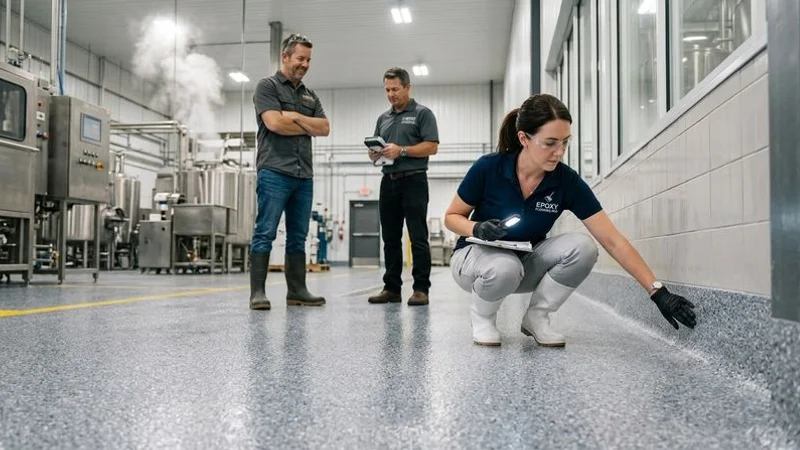
Before your next HACCP or OSHA audit, verify that your floor system meets all current criteria. SQF Edition 9 Module 11 clearly states that floors must be smooth, impact-resistant, and sloped to drain.
Use this checklist to self-audit your facility:
- No cracks, chips, or delamination exposing the concrete substrate beneath.
- Intact cove base at all wall-to-floor transitions.
- Proper drainage with absolutely no standing water after wash-down.
- Adequate slip resistance validated in all wet and greasy areas.
- Seamless transitions around drains, equipment pads, and penetrations.
- Documentation of floor system specification, installation, and maintenance records.
Facilities with aging or damaged floor systems should address deficiencies immediately. Proactive concrete & joint repair and re-coating is always less expensive than the production disruption of an audit failure.
Planning Your Food Processing Flooring Project
Flooring projects in active food processing facilities require careful scheduling to minimize production impact.
Our project managers work directly with facility directors to develop phased installation plans. Careful scheduling keeps your production lines running while upgrading floor systems zone by zone.
We coordinate directly with your sanitation team to ensure curing times align with your downtime windows.
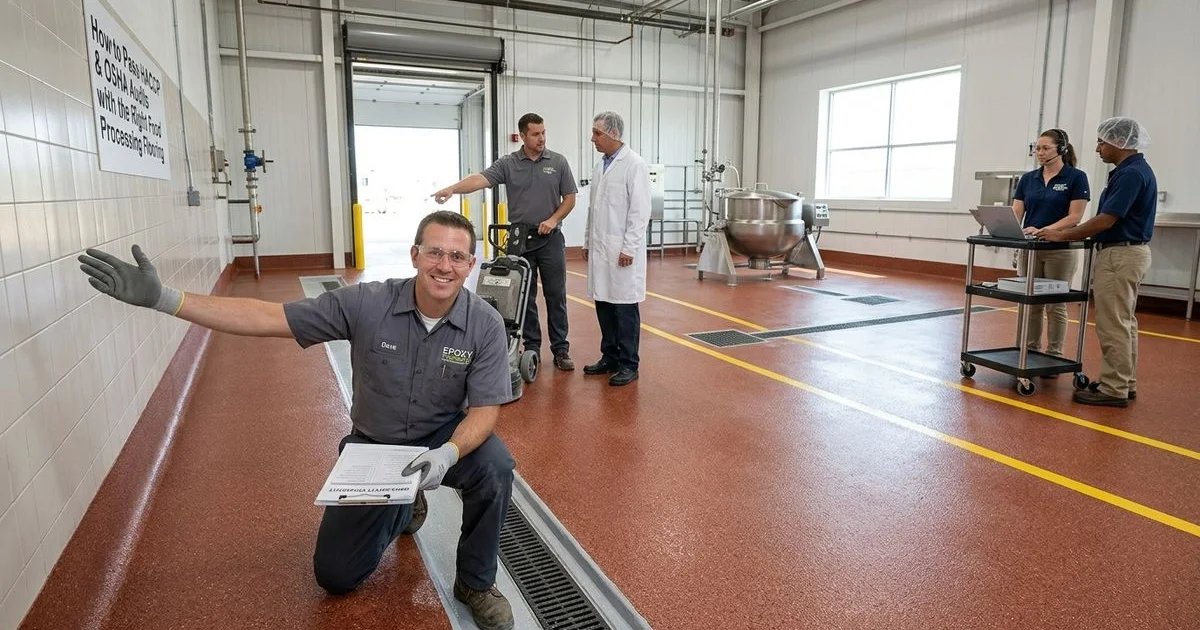
Explore our food and beverage flooring solutions or contact our team to schedule a facility assessment. We can show you exactly how to pass HACCP & OSHA audits with the right food processing flooring in your facility.
Need Help With Your Floor Coating Project?
Our project managers provide free on-site assessments tailored to your facility.
Get a Free Estimate