What Is Flake Broadcast Flooring?
Every facility manager knows the struggle of finding a commercial floor that handles heavy machinery while still impressing visiting clients.
You often have to choose between a dull industrial slab and a premium surface that drains the budget.
Our team at Epoxy Flooring Pro has installed countless commercial systems across the US, and flake broadcast flooring systems consistently solve this exact problem.
This multi-layer surface, also known as a chip coating, involves broadcasting colored vinyl flakes into a wet epoxy resin.
The process creates a highly durable surface that hides concrete imperfections and resists harsh chemicals.
These flake systems are among the most versatile and cost-effective decorative floor coatings available today.
They bridge the gap between basic solid-color epoxy and premium metallic systems.
You get an attractive finished product at a realistic mid-range price point.
Let’s look at the exact data on how these systems perform, and explore the best ways to specify this system for your next project.
How Flake Broadcast Systems Are Constructed
A properly installed flake broadcast system consists of four distinct layers.
Each layer serves a specific function to ensure long-term performance.
Skipping or rushing any of these steps guarantees premature failure.
Layer 1: Penetrating Epoxy Primer
A low-viscosity epoxy primer is applied directly to the prepared concrete.
The primer penetrates the concrete pore structure, creating a mechanical and chemical bond.
Primer adhesion dictates the lifespan of the entire floor.
We require a Concrete Surface Profile (CSP) of 2 or 3 for all professional flake installations.
The International Concrete Repair Institute defines a CSP 2 or 3 as a texture similar to coarse sandpaper.
This profile is achieved through mechanical diamond grinding using 16-grit or 25-grit tooling as part of thorough concrete surface preparation.
Without this specific roughness, the primer simply sits on top of the concrete and eventually peels away under heavy traffic.
Layer 2: Pigmented Base Coat
A 100% solids epoxy body coat is then applied at 10 to 16 mils wet film thickness.
This layer acts as the foundational adhesive for the decorative chips.
Using a 100% solids formulation ensures the coating will not shrink as it cures.
The base coat color must complement your chosen flake blend.
In a partial broadcast application, the base color remains highly visible between the individual flake particles.
For a full broadcast application, this color acts as an insurance policy.
If a tiny gap occurs between flakes, a matching base color keeps the floor looking completely uniform.
Layer 3: Vinyl Flake Broadcast
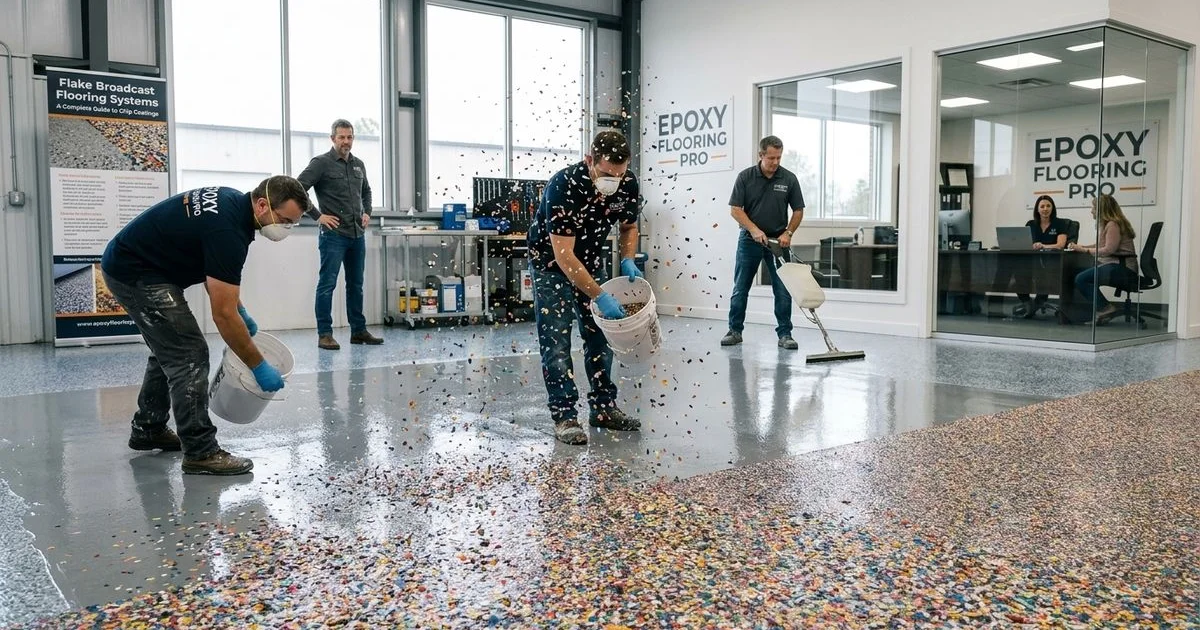
While the base coat is still wet and tacky, installers throw colored vinyl chips upward by hand.
The flakes fall randomly onto the surface to create the signature patterned look.
The broadcast density directly determines your final appearance and built-in slip resistance.
- Light broadcast (20 to 30 percent): The base coat remains clearly visible between scattered flakes, creating a spotted appearance.
- Medium broadcast (50 to 70 percent): The floor is mostly covered with some base coat showing through, offering a balanced aesthetic.
- Full broadcast (100 percent): The floor is completely saturated with flakes, leaving no base coat visible.
We consider a full broadcast the definitive industry standard for US commercial installations.
A full broadcast typically requires about one standard box of flakes to cover 250 square feet at 100% refusal.
This heavy application provides the best substrate concealment and the highest slip resistance.
Layer 4: Clear Protective Topcoat
After the base coat and embedded flakes cure completely, technicians scrape the loose excess flakes flat and vacuum the floor.
A clear protective topcoat is then applied to seal the textured surface.
This final layer provides the necessary chemical defense and establishes the gloss level.
The topcoat acts as the primary wear surface against forklift traffic, footsteps, and daily abrasion.
Color Options and Custom Blending
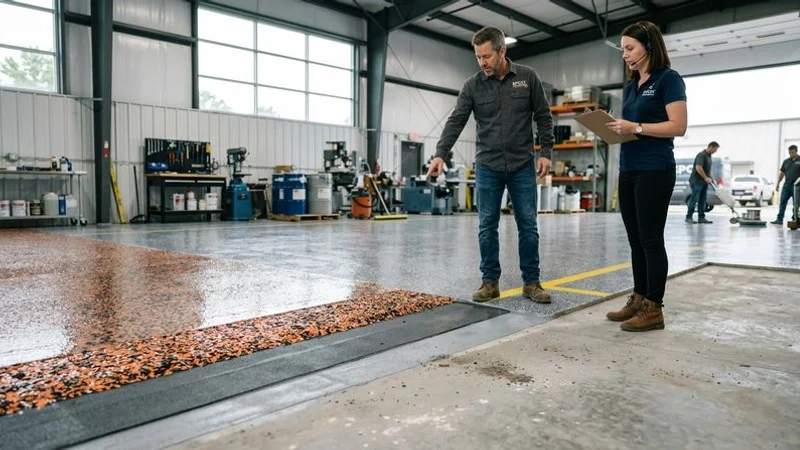
Vinyl flakes are manufactured from acrylic resins in a wide range of colors.
You can select pre-mixed combinations or design specific batches to match virtually any facility vision.
Facility managers generally choose between two categories:
- Standard blends: These are pre-mixed color combinations designed to work with common interior aesthetics. Popular standards include Saddle Tan, Midnight, Granite, Autumn, and Coastal. These blends are stocked by most US manufacturers, making them readily available and highly cost-effective for tight deadlines.
- Custom blends: This option allows you to mix individual flake colors in precise proportions. You can easily match corporate brand colors or establish color-coding schemes for safety zones. Custom batches require minimum order quantities but provide unlimited design flexibility.
Flake sizes are available in 1/16 inch, 1/8 inch, 1/4 inch, and 1/2 inch dimensions.
The 1/4 inch flake is the undisputed standard for commercial projects because it provides the perfect balance of visible patterning and surface uniformity.
Smaller flakes produce a very subtle texture, while 1/2 inch chips create bold patterns best suited for massive open spaces.
Ideal Commercial Applications
Flake broadcast systems are adaptable to almost any commercial environment.
They solve very specific operational challenges across different industries.
Automotive Showrooms and Garages
This is the original and most iconic application for a chip floor.
The heavily patterned surface effortlessly hides tire marks, dirt, and dust.
The 100% solids base coat easily resists hot tire pickup from vehicles parked for extended periods.
Our automotive clients consistently report that these floors transform utilitarian shop spaces into bright, attractive environments.
The visual upgrade is immediate and highly profitable.
Retail and Commercial Spaces
Custom flake blends align directly with a company’s brand identity.
The resulting floor provides exceptional resistance to constant foot traffic, heavy rolling displays, and incidental liquid spills.
Retailers specifically choose flake systems to solve three common operational issues:
- Staining: The seamless topcoat prevents permanent marks from dropped merchandise.
- Cleaning: The non-porous surface withstands harsh commercial cleaning chemicals.
- Safety: The built-in texture prevents slip-and-fall accidents near entryways, addressing slippery industrial floors concerns.
Healthcare and Veterinary Clinics
A seamless flake floor eliminates the grout lines and joints where bacteria typically multiply.
The non-porous surface is easily sanitized using standard hospital-grade disinfectants.
Light-colored blends, such as the popular Coastal mix, actively brighten clinical spaces.
This high light reflectivity makes cleanliness visually obvious and reinforces patient confidence.
Break Rooms and Restrooms
Areas prone to water and beverage spills require reliable traction to prevent workplace injuries.
The inherent texture created by a full flake broadcast provides excellent slip resistance.
You get safe footing in these wet environments without needing gritty aluminum oxide additives.
Durability and Performance Characteristics
Flake broadcast systems deliver exceptional long-term performance relative to their installation cost.
When maintained properly, a professional installation can last 10 to 20 years in a commercial setting.
| Property | Performance Level |
|---|---|
| Abrasion resistance | Moderate to high (topcoat dependent) |
| Chemical resistance | Good against most common industrial chemicals |
| Impact resistance | Moderate (the heavy flake layer adds total thickness) |
| Slip resistance | Good to excellent (inherent texture from the flake profile) |
| UV stability | Excellent when paired with a polyaspartic topcoat |
| Maintenance routine | Daily sweep plus a weekly damp mop |
| Average service life | 10 to 20 years in heavy commercial environments |
”A common mistake facility managers make is treating a flake floor like polished concrete. Avoid stiff-bristled scrubbers. A simple microfiber mop and a neutral pH cleaner will keep the topcoat clear and intact for over a decade.”
Topcoat Selection: The Most Critical Decision
The topcoat serves as the primary wear surface.
Your choice of topcoat is the single most important factor in the long-term performance of the entire flooring system.
Polyaspartic Topcoats
A polyaspartic coating is a specialized aliphatic polyurea that cures exceptionally fast.
These topcoats typically cure in just 2 to 6 hours, drastically reducing facility downtime.
We recommend a polyaspartic topcoat for 90% of our commercial flake installations because it offers several distinct advantages:
- UV Stability: The floor will not yellow or fade when exposed to direct sunlight through windows.
- Chemical Resistance: It easily repels automotive fluids and industrial solvents.
- Gloss Retention: The surface maintains a high-end shine for years without waxing.
It combines these protective qualities with the fastest possible return to service.
Aliphatic Polyurethane Topcoats
Polyurethane topcoats provide exceptional scratch resistance and hardness.
They are highly effective at resisting harsh industrial chemicals and solvents.
The primary tradeoff is a significantly longer cure time, usually requiring 12 to 24 hours before light foot traffic can resume.
This longer curing window makes polyurethane a tough choice for businesses that operate 24/7.
That said, if your facility can handle the downtime, polyurethane delivers unparalleled wear resistance for extreme traffic zones.
Clear Epoxy Topcoats
Standard clear epoxy is the most economical topcoat option.
It provides a thick, protective layer over the flakes.
Unfortunately, standard epoxy is highly susceptible to ambering and chalking under UV exposure.
You should only specify a clear epoxy topcoat for fully enclosed spaces with absolutely no natural light, such as interior basement corridors or windowless storage rooms.
Cost Comparison With Other Decorative Systems
Budgeting for commercial flooring requires looking at the actual installed cost per square foot.
In 2026, professional material and labor rates across the US place flake flooring right in the optimal middle ground.
| Flooring System | Average 2026 Cost Per SF | Best Commercial Uses |
|---|---|---|
| Flake broadcast epoxy | $6 - $10 | Garages, retail, healthcare, break rooms |
| Metallic epoxy | $10 - $15 | High-end lobbies, luxury showrooms |
| Quartz broadcast | $8 - $12 | Commercial kitchens, food service, labs |
| Solid color epoxy (100% solids) | $5 - $8 | Industrial warehouses, production floors |
| Polished concrete | $3 - $12 | Big box retail, large open offices, warehouses |
Flake flooring offers the perfect compromise for facilities that want visual appeal without the premium price tag of metallic systems.
This combination of affordability, extreme durability, and design flexibility makes it a dominant choice in the current market.
Getting Started With Your Flake Floor Project
Every successful project utilizing flake broadcast flooring systems begins with a rigorous site assessment.
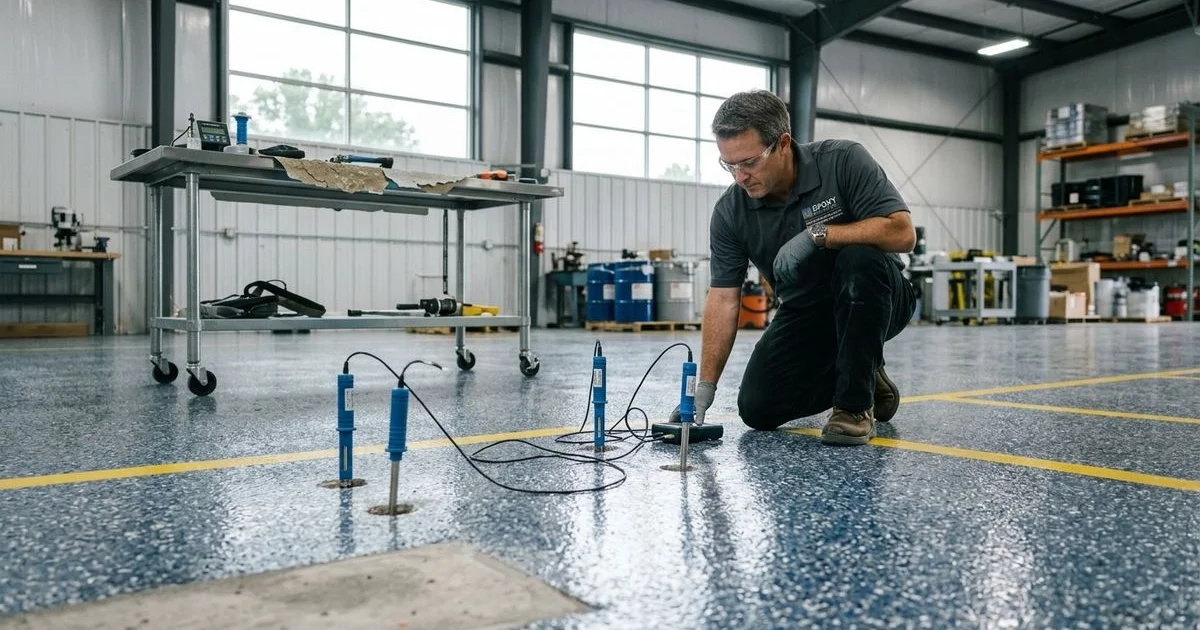
A flooring specialist must evaluate the current condition of your concrete slab, check for moisture issues, and determine the exact grinding requirements.
We follow this assessment with a detailed color consultation.
You can view physical flake samples directly at your facility under actual lighting conditions to ensure a perfect match.
Explore our decorative commercial flooring systems to see recent installations.
You can also contact us today for a free estimate and on-site color consultation for your facility.
Need Help With Your Floor Coating Project?
Our project managers provide free on-site assessments tailored to your facility.
Get a Free Estimate