Understanding the Two Most Popular Industrial Floor Coatings
We know the immense pressure plant engineers face to keep production lines moving. Recent 2026 industry data shows that unexpected downtime costs the average U.S. manufacturer roughly $260,000 per hour.
Our team regularly sees how a failed concrete surface can bring an entire loading dock to a halt. In high-volume sectors like automotive assembly, that downtime penalty can skyrocket to $3 million an hour, making the right flooring choice critical.
We see facility managers debate this exact question daily: Epoxy vs. Polyaspartic Coatings: Which Is Best for Michigan Industrial Facilities? Both deliver exceptional protection for concrete substrates, but they differ significantly in chemistry, application requirements, and long-term performance characteristics. Let’s look at the data, explore what it actually means for your daily operations, and build a plan to make a confident decision for your facility.
How Epoxy Floor Coatings Work
The Chemistry of Thermoset Polymers
We start by looking at the fundamental chemistry of epoxy coatings. These thermoset polymers form by mixing a resin component with a hardener. The exothermic chemical reaction creates a rigid, cross-linked molecular structure that bonds tenaciously to properly prepared concrete. Our installers rely on 100% solid epoxy systems because they contain no solvents or water carriers. Every drop applied becomes part of the finished film.
This specific formulation delivers superior build thickness in fewer coats compared to water-based alternatives. A single coat of 100% solid epoxy easily achieves 8 to 12 mils of dry film thickness. Water-based systems typically max out at a mere 3 to 5 mils per coat. Proper concrete surface preparation is essential before applying any of these systems.
Application Temperature and Cure Times
We must emphasize the strict environmental requirements for this material. Standard epoxy systems demand 12 to 24 hours before allowing light foot traffic. Full mechanical loading requires a minimum 72-hour wait. Our crews carefully monitor ambient conditions because temperatures below 50 degrees Fahrenheit prevent proper curing.
Cold weather severely restricts installation schedules in Michigan. The ideal application window sits tightly between 55 and 90 degrees Fahrenheit. If you try to force an application in a freezing warehouse, the chemical reaction stalls completely.
Pro-Tip: Never attempt an epoxy installation if your facility’s internal temperature drops below 50 degrees Fahrenheit, as the chemical bonding process will permanently stall and ruin the surface.
How Polyaspartic Coatings Work
Aliphatic Reactions and Rapid Curing
We often recommend polyaspartic coatings for facilities that require immediate return to service. This material is a specialized subset of polyurea technology. The coating cures through an aliphatic isocyanate reaction that easily ignores extreme weather. Our data shows a standard polyaspartic application reaches foot-traffic readiness in just 2 to 4 hours.
Forklifts can safely resume normal routes within 8 to 12 hours. This rapid timeline completely changes the math for managers facing massive hourly downtime penalties. The installer’s working window is much shorter, usually offering a pot life of only 30 minutes compared to epoxy’s 60 minutes.
Extreme Temperature Flexibility
We utilize polyaspartic technology specifically to beat the cold weather limits. Installers can apply these systems in temperatures as low as minus 30 degrees Fahrenheit. This extreme versatility means you can schedule floor renovations in the dead of winter without heating an empty warehouse.
The aliphatic chemistry provides several distinct environmental advantages:
- Sub-Zero Application: Installs smoothly in temperatures well below freezing.
- UV Stability: Resists the yellowing and chalking common in sunlit areas.
- Moisture Tolerance: Performs effectively even during humid Michigan spring months.
Epoxy vs. Polyaspartic Coatings: Which Is Best for Michigan Industrial Facilities?
Durability and the Hardness Myth
We need to correct a common industry misconception right now. Many marketing brochures claim polyaspartic is “four times harder” than epoxy. The industry standard Shore D hardness scale proves this is mathematically impossible, as the scale maxes out at 100. Our suppliers’ technical data sheets show most 100% solid epoxies rate between 80 and 90 on the Shore D scale.
Polyaspartics usually score slightly lower, resting between 70 and 75. Epoxy genuinely outperforms polyaspartic in pure, rigid hardness. A 12-mil epoxy surface handles heavy point-loading from steel-wheeled equipment better than any alternative.
Polyaspartic wins in toughness and flexibility rather than pure hardness. Concrete expands and contracts dramatically during Michigan’s severe freeze-thaw cycles. The slight flexibility of a polyaspartic layer allows it to stretch with the slab, preventing the micro-cracking that plagues rigid epoxy floors.
Chemical Resistance Profiles
We evaluate your specific chemical exposure before making any recommendation. Epoxy coatings excel in environments handling highly aggressive substances. Facilities managing strong acids, alkalis, and petroleum products see exceptional service life from epoxy. A specialized Novolac epoxy provides the ultimate defense if your floor faces constant battery acid spills.
Polyaspartic handles routine automotive fluids and road salts effortlessly. Brake fluid and standard degreasers wipe right off the non-porous surface. Prolonged exposure to highly concentrated industrial solvents will damage a polyaspartic finish faster than an epoxy one. Facilities dealing with severe chemical damaged floors often need specialized remediation before recoating.
Cost Considerations and Return on Investment
We urge clients to look past the initial price per bucket. Professional epoxy installations average between $4 and $10 per square foot in 2026. Polyaspartic materials cost slightly more, usually landing between $5 and $12 per square foot depending on the exact specification.
The true financial comparison requires factoring in your facility’s specific hourly downtime cost. A cheap floor that demands a five-day shutdown costs infinitely more than a premium floor finished over a single weekend.
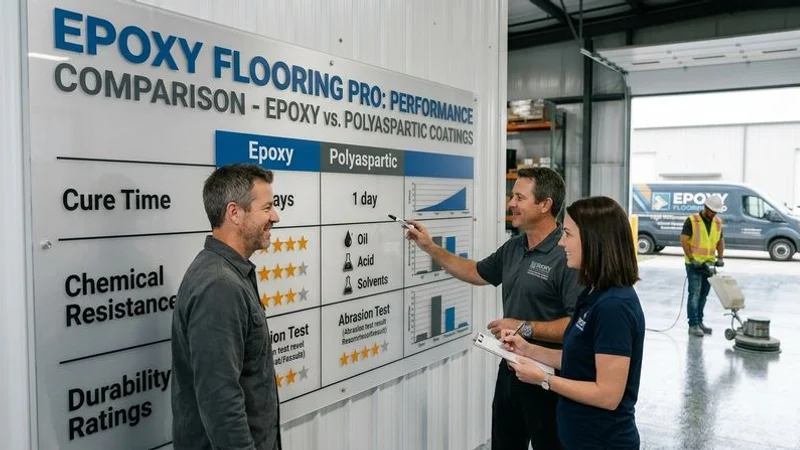
| Feature | 100% Solid Epoxy | Polyaspartic Coating |
|---|---|---|
| Average Cost per Sq. Ft. | $4 - $10 | $5 - $12 |
| Foot Traffic Cure Time | 12 - 24 Hours | 2 - 4 Hours |
| Application Temp Limit | Minimum 50°F | Down to -30°F |
| Shore D Hardness | 80 - 90 (Rigid) | 70 - 75 (Flexible) |
When to Choose Epoxy
We guide clients to an epoxy installation under specific operational conditions. This traditional chemistry still dominates certain heavy industrial sectors.
- Heavy Machinery Zones: The 80 to 90 Shore D hardness easily supports extreme point-loading from heavy steel wheels.
- Constant Chemical Contact: Novolac epoxy handles sustained battery acid and strong solvent exposure perfectly.
- Controlled Climates: The facility must stay consistently above 50 degrees Fahrenheit during the entire curing phase.
- Zero Sun Exposure: The installation area should lack direct sunlight to prevent inevitable yellowing.
- Flexible Schedules: Your operations can easily accommodate a 72-hour shutdown.
When to Choose Polyaspartic
We specify a polyaspartic system when speed and weather resistance dictate the project parameters. This advanced resin solves several immediate logistical headaches.
- Urgent Timelines: You need a complete return to service within 24 hours to avoid staggering downtime fees.
- Winter Installations: The project must proceed immediately, even if warehouse temperatures drop below freezing.
- Thermal Cycling Environments: The concrete slab experiences drastic temperature swings and requires a flexible coating.
- Bright Spaces: Sunlit loading docks and window-heavy facilities require permanent UV stability.
- Salt and Brine Exposure: The surface faces heavy winter road salt dragged in by delivery fleets.
The Hybrid Approach: Best of Both Worlds
We install hybrid systems for many Michigan clients who want maximum performance without compromise. This strategy uses multiple specific layers to capitalize on the unique strengths of both chemical formulas. Our crews apply a 100% solid epoxy base coat directly to the prepared concrete.
This thick base layer delivers incredible adhesion and pure compressive strength right where heavy loads hit. We then finish the floor with a topcoat of clear polyaspartic resin. You gain the scratch resistance and perfect UV stability of polyaspartic right on the wear surface.
This layered approach typically costs between $7 and $10 per square foot, offering premium protection at a sensible middle-ground price.
Making the Right Decision for Your Facility
We know that answering the question of Epoxy vs. Polyaspartic Coatings: Which Is Best for Michigan Industrial Facilities? depends entirely on your specific operational requirements. There is no universally superior option. Your chemical exposure profile, daily downtime tolerance, and budget parameters will dictate the final specification.
We recommend starting with a thorough facility assessment. A proper evaluation checks current concrete conditions, local environmental factors, and precise performance requirements before a single drop of resin is mixed. Our team at Epoxy Flooring Pro provides complimentary on-site evaluations for Michigan industrial facilities.
Ready to explore your options? Learn more about our complete range of epoxy and urethane flooring systems or request a free consultation to discuss your project requirements with our team.
Need Help With Your Floor Coating Project?
Our project managers provide free on-site assessments tailored to your facility.
Get a Free Estimate