Why Surface Preparation Determines Coating Success
We see facility managers constantly underestimating the true financial risk of a failing concrete floor. A failing industrial floor disrupts entire production schedules.
The International Concrete Repair Institute estimates that 70 percent of all floor coating failures result directly from inadequate surface preparation.
Our team knows that skipping proper profiling leads directly to disaster. Recent 2026 industry data shows that unplanned downtime in US manufacturing averages a staggering $260,000 per hour.
The most advanced coating system will simply peel away from concrete that has not been properly cleaned, resulting in failing floor coatings that require costly remediation. When evaluating Shot Blasting vs. Diamond Grinding: Choosing the Right Surface Prep Method is the essential step to prevent those massive financial losses.
Proper preparation creates a mechanical bond profile and removes weak surface layers. Shot blasting and diamond grinding are the two primary methods for this task. Let’s look at the data and explore how to choose the right technology for your next project.
Understanding Concrete Surface Profile
The ICRI defines 10 levels of concrete surface profile (CSP) under their 310.2R guideline. These range from CSP-1 for thin sealers through CSP-10 for extremely rough, heavy mortar systems.
Our installers rely on these strict guidelines to ensure every coating bonds perfectly. Every coating manufacturer specifies a strict CSP range for their products. Applying a coating outside that range causes immediate adhesion failure or excessive material consumption.
Major US manufacturers require exact profiles for their high-performance systems. We frequently install Sherwin-Williams industrial floor coatings across various facilities. For their 15 to 40 mil thick epoxy systems, Sherwin-Williams mandates a surface profile of CSP 3 to 5. Matching the preparation method to the required CSP is the fundamental decision in surface preparation planning.
| CSP Level | Surface Feel | Typical US Coating Applications |
|---|---|---|
| CSP 1-2 | Smooth with slight texture | Thin-film sealers, stains, densifiers |
| CSP 3-4 | Medium texture, visible profile | Most epoxy coatings, polyaspartic systems |
| CSP 5-6 | Aggressive texture | Thick-build epoxy, urethane cement, overlays |
| CSP 7-10 | Very rough, visible aggregate | Heavy-duty mortar systems, broadcast floors |
Shot Blasting: Speed and Consistency for Large Areas
Shot blasting uses a centrifugal wheel to propel hardened steel shot at the concrete surface at high velocity. The impact fractures and removes the surface layer of concrete to create a consistent mechanical profile.
Our crews typically utilize top-tier equipment like the Husqvarna Blastrac 1-10DS for medium to large US projects. An integrated vacuum system captures both the spent shot and concrete debris for recycling and disposal.
How Shot Blasting Works
The self-propelled machine travels across the floor at a controlled speed. Steel shot is accelerated by a rotating blast wheel and directed downward onto the concrete surface.
Our operators often use S330 size steel shot to achieve an aggressive CSP 5 on heavily trafficked warehouse floors. The impact energy fractures the surface layer, and the rebounding shot carries the fractured material into a recovery system. The machine separates the shot from the debris, cleans it, and recirculates it continuously.
We adjust the machine travel speed and shot flow rate to control the exact profile depth. Slower speeds and higher shot volumes produce deeper profiles. Experienced operators dial in specific CSP levels with high repeatability across large floor areas. Industry-leading machines can process up to 3,000 square feet per hour on open floors.
Shot Blasting Advantages
- High production rates: Reaches 3,000 to 5,000 square feet per hour on open floors.
- Consistent profile: Produces uniform CSP-3 through CSP-7 across the entire floor.
- Excellent dust control: Integrated vacuums capture virtually all debris at the point of generation.
- Effective contaminant removal: Strips existing coatings quickly, saving facilities thousands in labor costs compared to chemical stripping.
- One-pass operation: Achieves the required profile in a single pass for most applications.
Shot Blasting Limitations
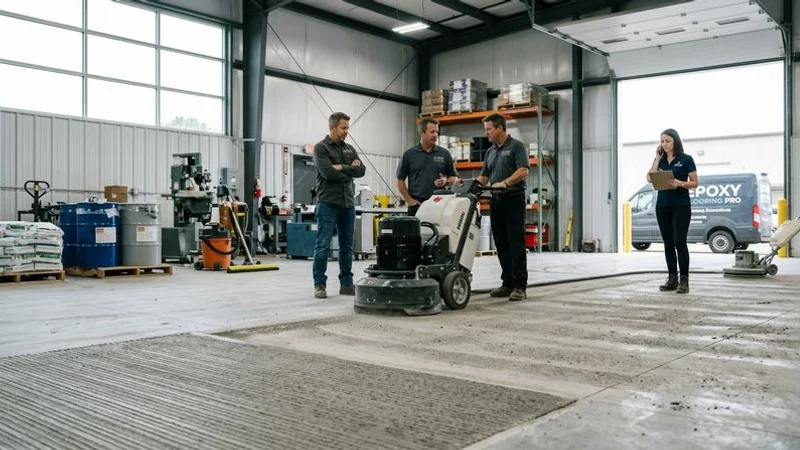
- Cannot reach edges: Small edge grinders like the Husqvarna Blastrac 1-8DM are essential to finish the perimeter where larger machines cannot fit.
- Not suitable for thin slabs: Impact force can damage concrete less than 4 inches thick.
- Follows floor contour: The machine rides on wheels and cannot correct levelness issues.
- Turn marks: Requires skilled operators to avoid visible overlap patterns at direction changes.
- Cannot achieve light profiles: Minimum achievable profile is CSP-3, which is too aggressive for thin-film sealers.
Diamond Grinding: Precision and Versatility
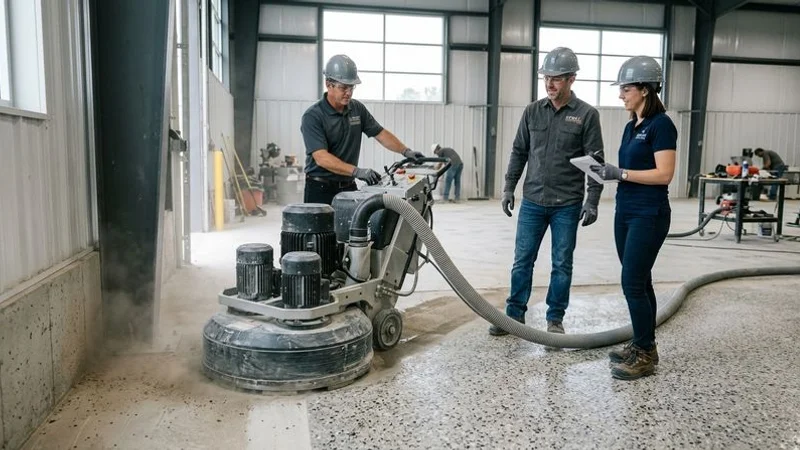
Diamond grinding uses rotating heads fitted with diamond-impregnated segments to abrade the concrete surface mechanically. Multi-head planetary grinders provide even material removal across a wide swath. Our teams use diamond tooling in grits ranging from coarse 16-grit to fine 3,000-grit depending on the project.
How Diamond Grinding Works
The machine uses a series of rotating discs or cups, each embedded with industrial diamonds in a metal or resin bond matrix. As the diamonds contact the concrete, they abrade the surface at a controlled rate determined by grit size, head pressure, and machine travel speed. We frequently attach Polycrystalline Diamond (PCD) tooling to strip thick, stubborn mastics that standard diamonds cannot handle.
Dust collection systems manage airborne particulate during the grinding process. These systems must comply with the 2026 OSHA permissible exposure limit (PEL) for respirable crystalline silica. The strict US PEL rule limits exposure to just 50 micrograms per cubic meter of air over an 8-hour shift. Our equipment pairs walk-behind grinders with HEPA-filtered vacuum systems to ensure complete compliance and worker safety.
Diamond Grinding Advantages
- Precision control: Can achieve any CSP level from 1 through 5 with high accuracy.
- Edge-to-edge coverage: Reaches within inches of walls, columns, and obstacles.
- Floor leveling capability: Removes high spots and corrects minor levelness issues during preparation.
- Gentle on concrete: Eliminates the risk of micro-fracturing on thin or elevated slabs, a common issue documented by structural engineers when impact methods are used incorrectly.
- Progressive refinement: Same equipment transitions from coarse grinding through polishing, which is the foundation of our concrete surface preparation services.
Diamond Grinding Limitations
- Lower production rates: Achieves 500 to 2,000 square feet per hour depending on profile and concrete hardness.
- Diamond wear costs: Hard aggregates such as flint and granite consume diamonds faster and increase consumable costs.
- Slow for thick removal: Removing heavy existing coatings or significant concrete depth takes considerable time without specialized PCD tooling.
- Dust management requires attention: Vacuum systems must be properly maintained and strictly monitored to meet OSHA silica dust standards.
Head-to-Head Comparison
The choice between these two methods comes down to speed, profile depth, and precision. We rely on both technologies, but they serve very different purposes.
A typical 50,000-square-foot facility will see vastly different preparation timelines depending on the chosen method. Diamond grinding that massive space could take over a week, while shot blasting might finish the bulk of the floor in just three days.
| Factor | Shot Blasting | Diamond Grinding |
|---|---|---|
| Production rate | 3,000-5,000 SF/hour | 500-2,000 SF/hour |
| CSP range | CSP 3-7 | CSP 1-5 |
| Edge access | No (needs supplemental grinding) | Yes |
| Floor leveling | No | Yes |
| Coating removal | Excellent | Moderate |
| Dust control | Excellent (integrated) | Good (requires HEPA vacuum) |
| Concrete damage risk | Moderate on thin slabs | Low |
| Equipment cost | High | Moderate to high |
When to Use Both Methods Together
The most efficient approach for large US industrial projects combines both technologies. Shot blasting covers the open floor area at maximum production rates while diamond grinding finishes edges, corners, transitions, and areas around equipment.
Our crews use this hybrid approach to maximize project efficiency without sacrificing coverage or profile quality. On a typical 50,000-square-foot warehouse project, the combined approach reduces total preparation time by 30 to 40 percent compared to using either method exclusively.
Saving three days of preparation time directly prevents over $18 million in potential downtime losses for a high-volume automotive manufacturing plant. We prioritize this combined method to get your facility back online as quickly as possible.
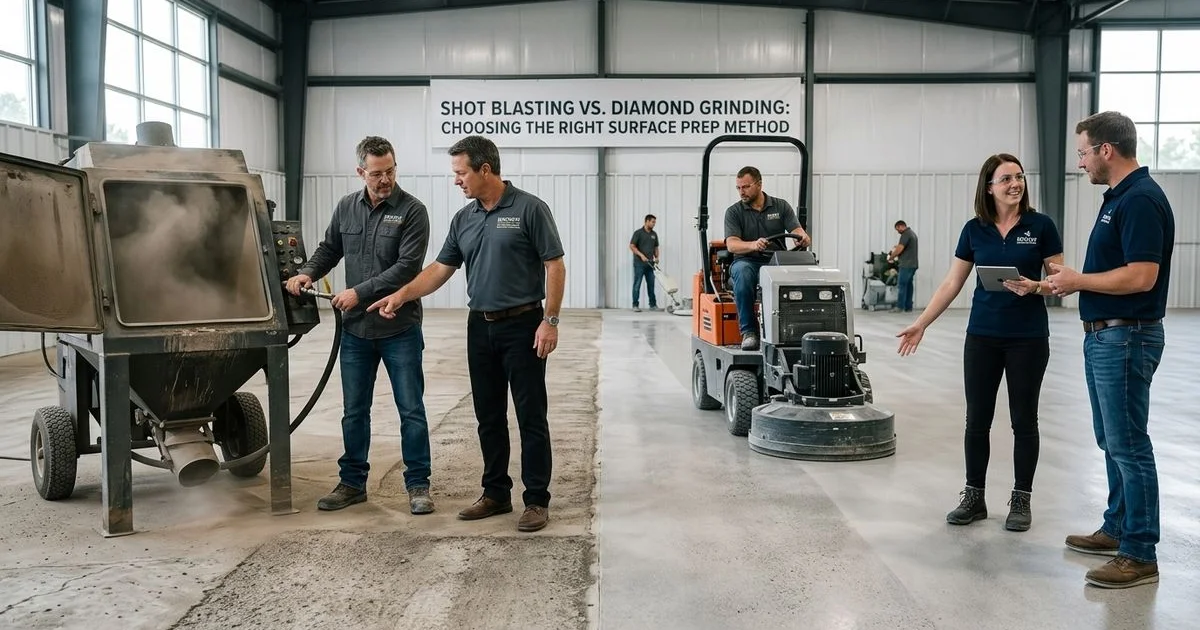
Shot Blasting vs. Diamond Grinding: Choosing the Right Surface Prep Method
The decision between shot blasting and diamond grinding should be driven by three critical factors.
- Required CSP: Match the preparation method to the coating manufacturer’s specified profile range.
- Project size and geometry: Large open areas favor shot blasting, while complex layouts with many obstacles favor grinding.
- Concrete condition: Heavily contaminated or coated floors often require shot blasting for rapid, effective removal.
Our team evaluates all three factors during the pre-project assessment to specify the optimal preparation approach for your specific US facility conditions. A properly prepared floor is the only way to guarantee the longevity of your new coating system.
We invite you to learn more about our concrete preparation and repair services or contact us to discuss your project requirements.
Need Help With Your Floor Coating Project?
Our project managers provide free on-site assessments tailored to your facility.
Get a Free Estimate