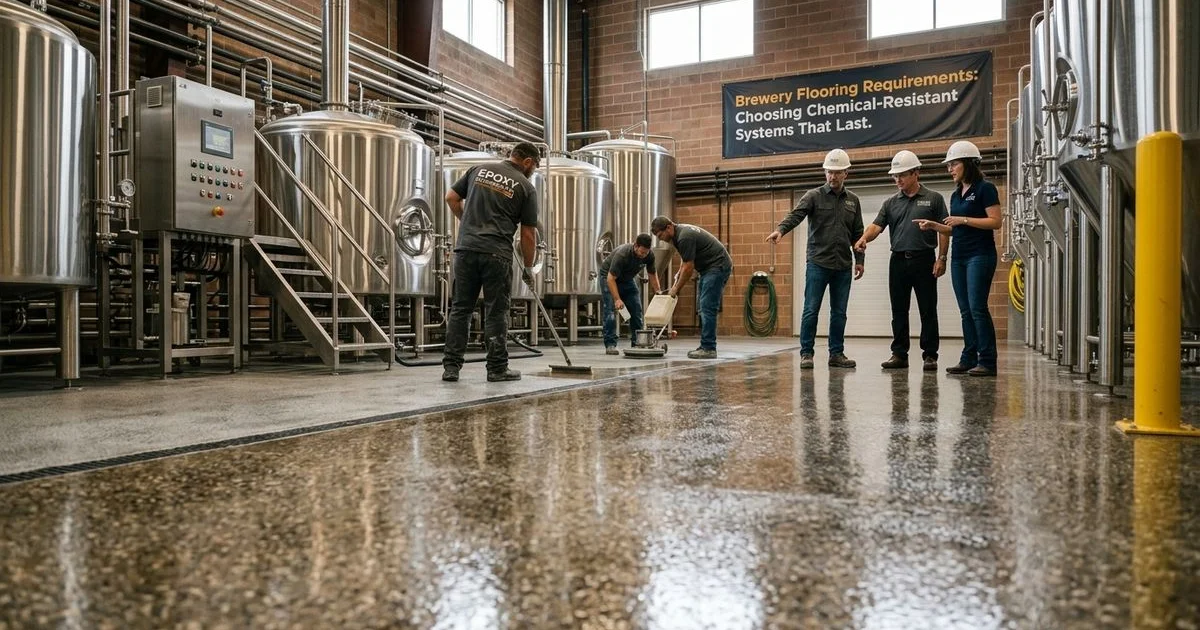
Finding the right setup for your facility is the core challenge behind Brewery Flooring Requirements: Choosing Chemical-Resistant Systems That Last. Our team at Epoxy Flooring Pro sees the consequences of inadequate surface choices in the US food and beverage sector every week.
Facility managers often learn the hard way that a standard parking garage coating cannot survive the daily abuse of a brewhouse.
The dividing line between a lasting surface and a costly failure usually comes down to specific material properties. We repair dozens of these blistered, peeling floors after they degrade within the first year.
This early deterioration forces unexpected shutdowns and wreaks havoc on production schedules. Let’s examine the hard data behind these rapid coating failures.
You will then discover the exact workarounds required to build a surface that genuinely lasts. Our goal is to help you eliminate those costly production interruptions.
Why Standard Epoxy Fails in Breweries
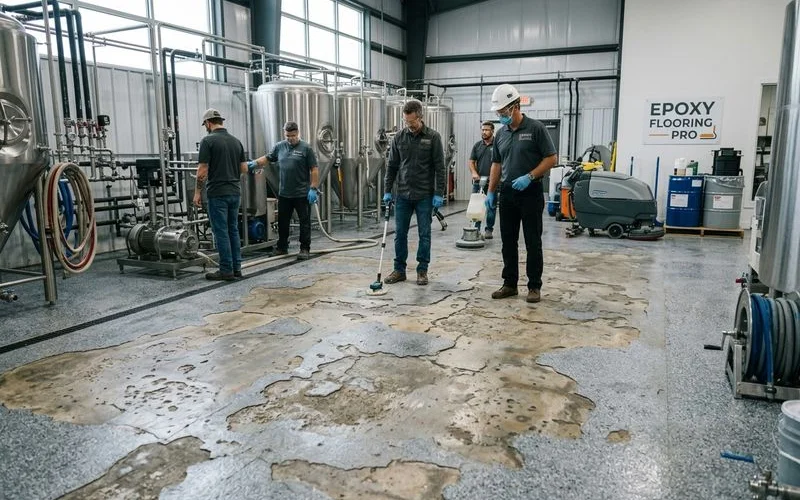
Breweries are among the toughest environments for industrial coatings in the entire manufacturing sector. Our installers frequently replace basic epoxy systems that general contractors mistakenly applied to these demanding production spaces. The combination of harsh cleaners, constant moisture, and heavy keg traffic creates conditions that destroy standard applications within months.
Thermal shock is typically the primary culprit behind these rapid failures. This phenomenon occurs when hot wash-downs hit cold concrete, causing the substrate and the rigid coating to expand at completely different rates. We consistently observe that this unequal expansion causes severe blistering and delamination.
Standard epoxy simply lacks the flexibility to handle these sudden temperature swings. You will notice the damage beginning near trench drains before it spreads across the entire production room.
The Brewery Chemical Challenge
Our assessments show that brewing operations expose concrete to a uniquely harsh chemical cocktail. These liquids cycle between highly alkaline and intensely acidic pH levels multiple times every single day. Standard materials handle neither extreme well, often resulting in chemical damaged floors that require full remediation.
We design systems specifically to withstand the following common exposures:
- Caustic soda (NaOH): The Brewers Association notes that facilities use this at a 2 to 3 percent concentration heated up to 175°F for protein removal.
- Acidic detergents: Blends of phosphoric and nitric acid at 1 to 2 percent concentrations break down mineral scale.
- Sanitizers: Peracetic acid provides no-rinse sanitation but easily eats through weak sealers.
- Beer and wort spills: These hot, sugar-rich liquids are highly acidic with a pH ranging from 3.5 to 4.5.
- Thermal washes: Steam and boiling water dumped directly onto ambient-temperature surfaces create immediate stress.
Urethane Cement: The Brewery Standard
Facility owners need a material engineered for this specific type of abuse. A high-performance Urethane cement flooring system is the only resinous option capable of surviving these combined chemical and thermal threats. We strongly recommend this solution for any US food and beverage processing plant.
Recent 2025 construction data shows the upfront investment for heavy-duty urethane cement typically ranges from $10.00 to $15.00 per square foot in the US market. This cost easily pays for itself by preventing the massive expenses associated with facility downtime and early floor replacement.
Our installers see this heavy-duty system outperform traditional options across four critical categories.
Unmatched Thermal Shock Resistance
Industrial testing confirms our heavy-duty installations can withstand extreme temperature swings ranging from -50°F to over 200°F without cracking. Hot sanitation wash-downs will not damage or warp the thick cementitious coating.
Comprehensive Chemical Resistance
This material naturally repels the full spectrum of harsh brewing chemicals. We verify that it resists concentrated caustic soda, phosphoric acid, and the organic acids found in fermented beverages.
High Moisture Tolerance
These applications withstand constant wet conditions without blistering or lifting. We frequently apply the material directly onto green concrete with high moisture vapor transmission rates.
Superior Impact Resistance
Our clients rely on this durability to handle dropped kegs and heavy pallet jack traffic. The dense surface absorbs the mechanical shock of forklift loads without chipping.
Floor Design for Brewery Operations
A proper surface requires much more than just a durable topcoat. We approach every project as a complete, integrated system designed for maximum sanitation and safety.
Proper Slope to Drain
Standing water breeds harmful bacteria, creates severe slip hazards, and accelerates material degradation. We verify the concrete slope with laser levels before applying any resin. The surface must pitch at 1/8 to 1/4 inch per foot directly to the trench drains.
Integral Cove Base
An integral cove base eliminates the sharp 90-degree joint where the floor meets the wall. This smooth transition prevents liquids and organic matter from becoming trapped in hard-to-reach corners. We consider this seamless detail absolutely critical for maintaining strict HACCP compliance in food processing environments.
Aggressive Non-Slip Texture
Wet production rooms become dangerously slippery without the right surface profile, making slippery industrial floors a serious liability. According to 2024 US workplace data, fall-related incidents lead to over one million emergency room visits annually. We broadcast specialized anti-slip aggregate into the topcoat at densities carefully calibrated for heavy foot traffic. This texture must remain aggressive enough for worker safety but smooth enough for thorough cleaning.
Zone-Based System Selection
We know that not every single square foot of your building requires the thickest, most expensive material available. Facility managers can optimize their budgets by matching the specific resin to the unique demands of each production area. This targeted approach ensures maximum durability exactly where you need it most.
| Zone | Conditions | Recommended System |
|---|---|---|
| Brewhouse | Hot liquids, caustics, extreme thermal shock | Urethane cement (1/4” to 3/8” thick) |
| Cellar & Fermentation | Cold temperatures, constant wetness, acidic spills | Urethane cement (3/16” to 1/4” thick) |
| Packaging | Mechanical abuse, moderate moisture, heavy traffic | Heavy-duty epoxy or urethane cement |
| Taproom | High foot traffic, occasional spills, aesthetics | Decorative epoxy or polished concrete |
| Loading Dock | Forklift traffic, weather exposure, heavy impacts | Epoxy with aggressive anti-slip aggregate |
We highly recommend using a full 3/8-inch thickness near the hot liquor tanks and primary brewing kettles. You can then transition to slightly thinner profiles in the cooler fermentation cellars to save on material costs.
Installation Timing and Production Disruption
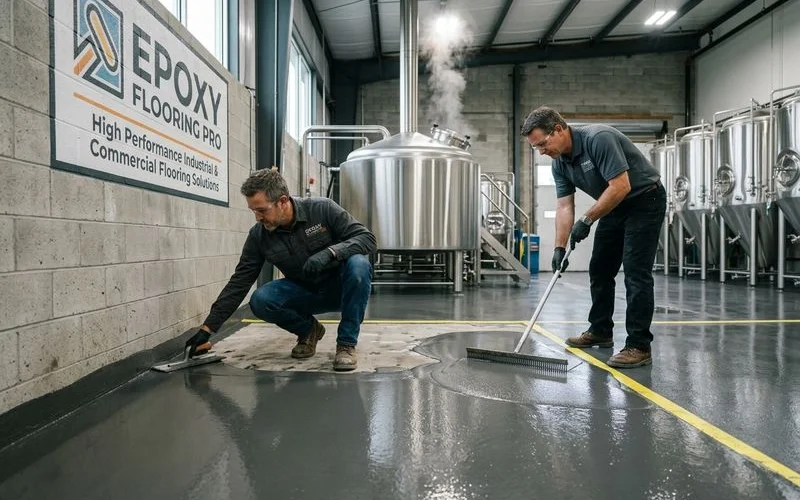
Resurfacing a production room requires careful coordination with your brewing schedule. We typically execute these upgrades in planned phases, taking one specific zone offline while your production safely continues in the others. This staggered method prevents complete facility shutdowns.
Fast-curing urethane cement systems offer a massive advantage for active facilities. These advanced materials can fully cure and return an area to heavy service in just 24 hours. We utilize these rapid-set formulas to minimize your operational downtime and protect your bottom line.
Brewery Flooring Requirements: Choosing Chemical-Resistant Systems That Last
Your production space takes more daily abuse per square foot than almost any other industrial facility. We want to ensure your business operations remain safe, sanitary, and fully compliant with US health regulations.
The right material, installed by experienced applicators, pays for itself by eliminating costly unexpected shutdowns for concrete repairs. Stop letting harsh chemicals and boiling water destroy your facility.
Upgrading your surfaces is the most effective way to address your Brewery Flooring Requirements: Choosing Chemical-Resistant Systems That Last.
We are ready to help you map out a durable, long-term solution. Contact us for a detailed site assessment today.
Need Help With Your Floor Coating Project?
Our project managers provide free on-site assessments tailored to your facility.
Get a Free Estimate